
It was 11:53 PM, and I was staring at the dark ceiling of my living room, waiting for the “feeling” to arrive.
I had been in the chair for twelve hours. My eyes burned from the screen glare, my back ached from the posture, and I had drank three cans of Diet Coke. I had worked harder today than anyone I knew.
Still… I felt like I hadn’t moved forward at all. I treated the day as a waste.
I craved tangibility. I wanted proof that my effort counted.
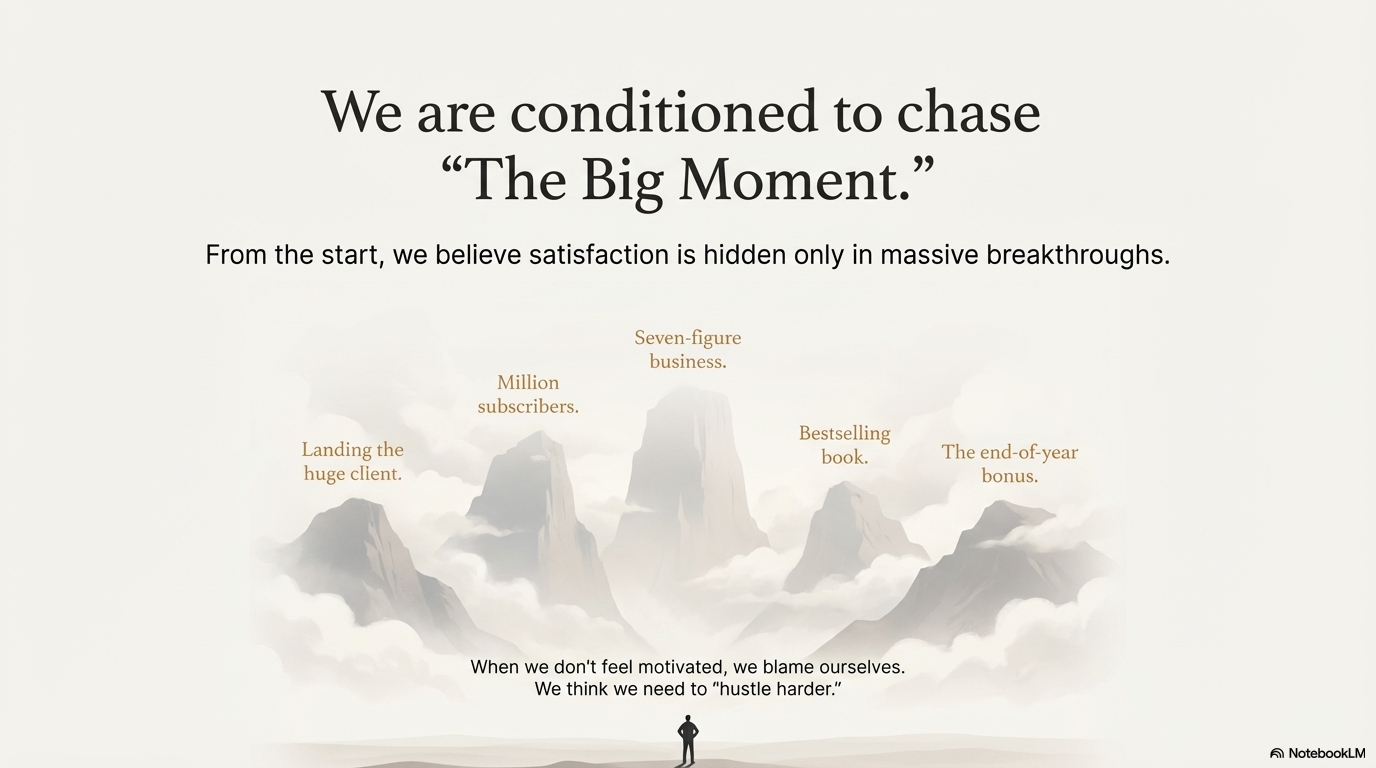
From the very start, we are conditioned to believe that “proof” is driven only by massive breakthroughs:
“Landing the huge client.”
“Million subscribers.”
“Seven-figure business.”
“Bestselling book.”
“Or receiving the end-of-year bonus.”
We think that satisfaction is hidden in these “big moments.” So when I didn’t feel it, I blamed myself. I thought I needed more discipline. I thought I needed to “hustle harder.”
But 5 days ago, I read about a study conducted by Teresa Amabile and Steven Kramer that changed the way I look and feel about myself. And today, I want to share it with you…
The best and shocking part for me was that this was not some “Flashy Inspiration” or a dumbed down report.
These researchers followed 238 employees on 26 project teams in 7 companies, collecting nearly 12,000 daily diary entries about what actually happened in their workdays and how they felt.
When they analyzed the data, they found a phenomenon they called “The Progress Principle.”
What is the Progress Principle?
When Amabile and Kramer analyzed those 12,000 entries to see what made people feel motivated, creative, and engaged, they found something that contradicted the “Big Moment” theory completely:
_“Of all the things that can boost emotions, motivation, and perceptions during a workday, the single most important is making progress in meaningful work.”
For you, as a creator, writer, or learner, that translates to a simple rule:
- Progress beats potential.
- A tiny real step beats a huge imagined leap.
If you felt strangely good after just 500 clean words, one tough conversation, or finally fixing a tiny system in your life, you’ve already felt the Progress Principle working.
The Inner Work Life: Why You Need “Visible” Progress
Amabile and Kramer used a phrase you’ll love: inner work life.
It is the constant stream of:
- Emotions (How do I feel about my work right now?)
- Perceptions (What story am I telling myself about my work, my team, my future?)
- Motivation (Do I want to do more of this?)
In their data:
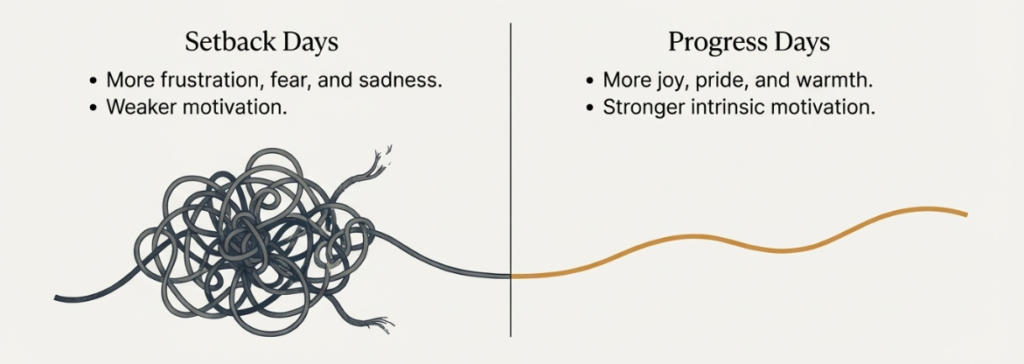
- Progress days were packed with more joy, pride and warmth, plus stronger intrinsic motivation.
- Setback days had more frustration, fear and sadness, plus weaker motivation.
Here’s the AHA:
You think your mood drives your progress.
The research shows your progress is quietly driving your mood.
That means:
- Your “I feel stuck” days are often lack-of-progress days.
- Your “I feel like a beast” days are usually I-moved-the-needle days.
So if you want better days, you don’t need a new life philosophy first.
You need one visible step forward, again and again.
Here’s the scientific explanation:
The Brain Science: Why Small Wins Feel Disproportionately Good
The Progress Principle feels almost unfair because small wins often feel huge.
Why?
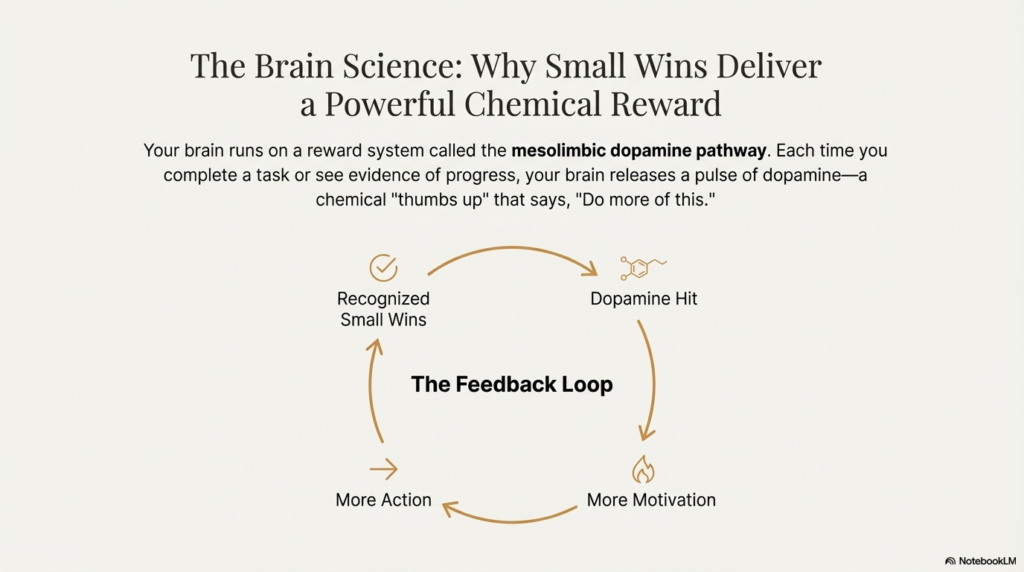
Your brain runs on a reward system called the mesolimbic dopamine pathway, which helps regulate motivation, drive and learning from rewards.
Each time you:
- Finish a task you believed you could finish
- Check off a box on your to-do list
- See a progress bar move closer to 100%
your brain gives you a dopamine pulse. This is a chemical “thumbs up” that says:
“Do more things like this. This matters.”
Over time:
- Recognized small wins → dopamine → more motivation → more action → more wins.
This is why progress tracking, streaks, and loyalty cards work so well.
Behavior scientists call part of this the goal gradient effect: as you get closer to a goal, your effort and motivation increase.
In one famous study, customers with a 10-stamp coffee card with 2 stamps already filled completed it faster than customers with a normal 8-stamp card, even though both required 8 coffees. The illusion of being “already on the way” made people work harder.
AHA moment:
Your brain doesn’t reward size of achievement.
It rewards evidence of moving closer.
If you never see your progress, your brain never gets that “keep going” signal.
Which brings us to the most practical part.
Also read: The Dopaminergic Curiosity System – the deeper neuroscience + practical loop for turning tiny wins into sustained drive.
How to Use The Progress Principle Work For You (Step by Step)
Here is where it gets practical.
1. Define “meaningful work” in your context
Progress only hits hard when it is tied to something that matters.
For you, meaningful work might be:
- Publishing (not just drafting)
- Shipping systems that make life easier
- Learning skills that fit your long-term identity
- Building assets that compound (blog, email list, portfolio, body of work)
Write this sentence somewhere visible:
- “Progress, for me, is: [your version].”
Every day, match your actions to that sentence.
2. Shrink the unit of progress
Big goals are terrible daily units.
Instead of “finish book,” make progress units like:
- Write 300 honest words.
- Fix one broken paragraph.
- Brainstorm 10 title ideas.
- Move one project from “stuck” to “moving.”
You are designing micro-wins that your brain can actually finish, see, and reward.
3. Make progress visible by having A “Done” List

Do not trust memory. Memory is biased.
Use anything that creates a visual signal:
- Daily word count log
- Habit tracker
- Kanban board (To Do → Doing → Done)
- Simple “Done list” at the end of the day
Each checkmark is a tiny lightbulb in your nervous system.
Most of us live by To-Do lists, which are reminders of what we haven’t accomplished. To leverage the Progress Principle:
- Track your wins: Keep a daily “Done List” or a “Got Done” diary.
4. Pair progress with reflection

Amabile’s research used daily diaries for a reason.
It is incredibly satisfying for your brain to see evidence of growth documented in black and white. Each time you reflect on a win, however small, your brain gets a “hit” of dopamine and says, “Let’s do that again!”
Over time, this biochemically conditions you to pursue more positive action.
How’s that for High-ROI? A few minutes of reflection can literally perk up your neurochemistry and boost your drive for the next day.
Try this nightly ritual. End your day with three short lines:
- “Today I made progress on…”
- “That matters because…”
- “Tomorrow’s next tiny step is…”
You are doing three things at once: reinforcing the win, connecting it to meaning, and lowering the friction for tomorrow’s action.
Why Most People Never Feel Progress (Even When They’re Making It)
The tragic part of Amabile and Kramer’s data is this:
Events that supported progress were present on a minority of days, and often went unnoticed by managers and workers.
In other words: People were making progress, but no one was naming it or tracking it. So their inner work life never got the upgrade.
In your own life, this looks like:
- You did 30 minutes of deep work, but judge yourself for not doing three hours.
- You wrote 300 words, but you compare it to someone’s book launch.
- You fixed one tiny system, but call the whole day “unproductive.”
You are making progress but refusing to count it.
This is like earning money, never checking your bank account, and then complaining you are broke.
The Progress Principle only works if progress is:
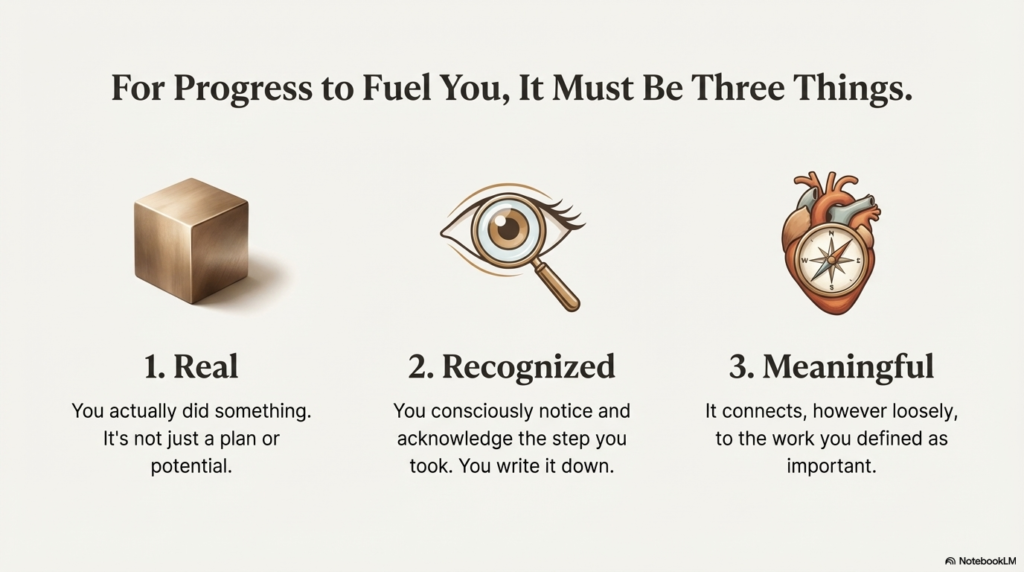
- Real (you actually did something).
- Recognized (you consciously notice it).
- Meaningful (it connects to something that matters to you).
Learning something that saves you 100 hours later is an invisible win until you write it down.
Also read: My Daily Learning Routine: Balancing Work, Growth, and Rest – a real-world routine that makes progress and reflection automatic instead of willpower-based.
The Operational Tool: Turning Science into System
We now have the science. We know that small, visible, meaningful steps are the engine of high performance.
But knowing the science isn’t enough.
If you try to “just remember” to make progress, the chaos of the day will take over. You need a container. You need a constraint-based architecture that forces you to shrink your goals and makes your wins visible by default.
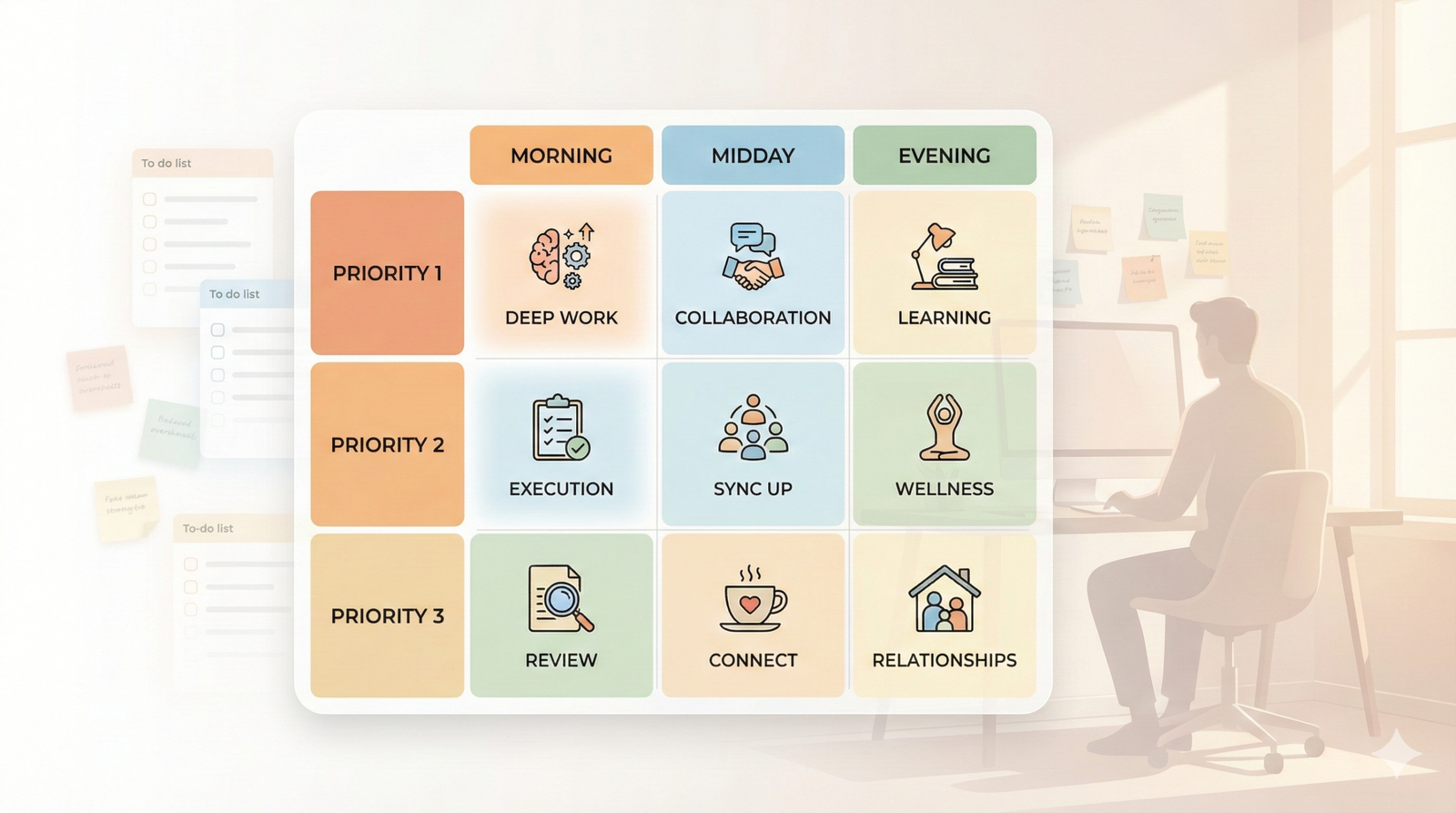
To operationalize all four of these steps into a single, workflow, I use The 3×3 System.
Bringing It All Together
If you zoom out, The Progress Principle is almost insultingly simple:
Make real progress on meaningful work, notice it, and protect the conditions that allow it to keep happening.
But under that simplicity sits:
- A multi-year diary study with thousands of data points showing that progress is the strongest driver of inner work life.
- Decades of neuroscience showing that tiny, repeated wins train your dopamine system to crave further action.
- Behavioral research showing that as you move closer to a goal, your motivation naturally intensifies.
For you, today, you don’t need a new app or a new identity ceremony.
You need:
- One clear definition of what meaningful progress looks like.
- One small step that fits that definition.
- One way to make that step visible to your future self.
Take that step. Write it down. Feel what happens inside your head and chest when you see the evidence.
That feeling is not random.
That feeling is your nervous system saying:
“This is it. This is the direction. Keep going.”
Also read: The Stages of Mastery: The Ultimate Guide to Skill Acquisition – the full map of how progress, identity, and practice compound into real mastery over time.
Cheers,
Dewansh Jain, signing off