
In 2009, engineers at Google made a discovery that terrified them. They found that a delay of just 400 milliseconds—literally the blink of an eye—in generating search results caused users to run 0.44% fewer searches.
That sounds negligible. But the drop didn’t recover. Even when the speed returned to normal, those users searched less. The friction had permanently altered their behavior.
Now, apply this to your life. You think you didn’t go to the gym because you lack “discipline.” You think you didn’t write this morning because you lack “inspiration.”
Science suggests otherwise. You failed because of the 400-millisecond delay. You failed because your gym clothes were in a drawer instead of on the floor. You failed because your guitar was in its case.
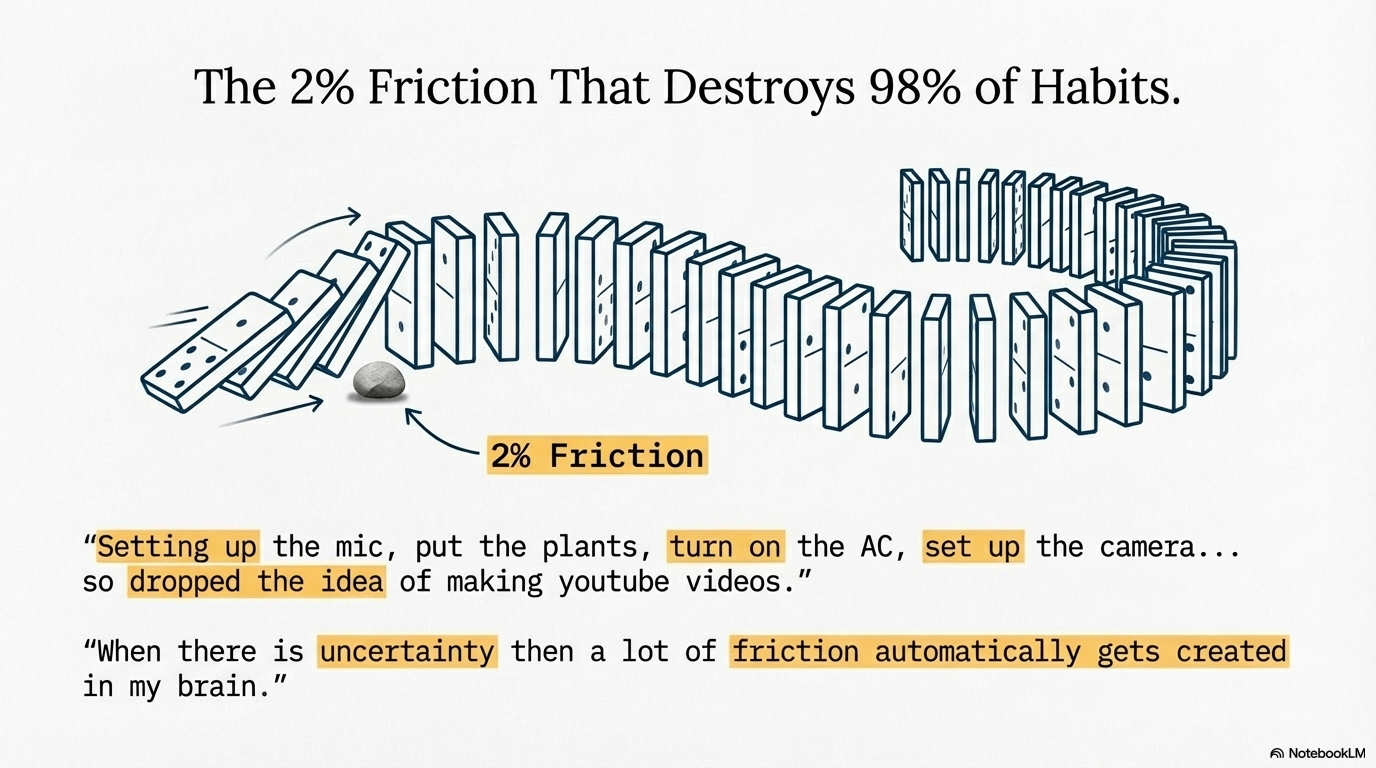
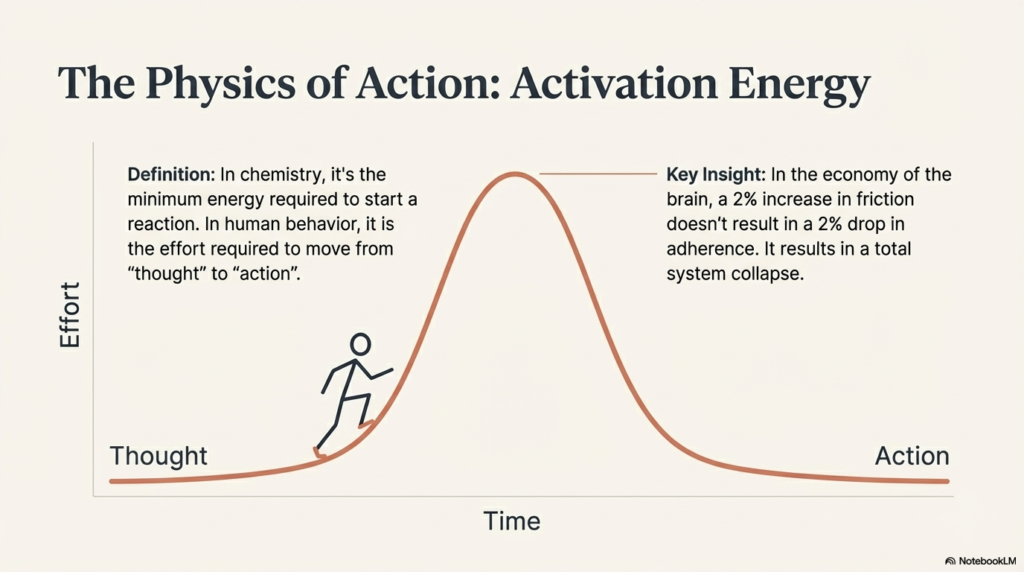
We are not rational optimizers; we are biological energy-misers. And in the economy of the brain, a 2% increase in friction doesn’t result in a 2% drop in adherence. It results in a total system collapse.
The Physics of “Activation Energy”
So even when you know Certain things are good for you but you choose not to do them…. WHY?
Because of the Activation Energy.
In chemistry, this is the minimum energy required to start a reaction. In human behavior, it is the effort required to move from “thought” to “action.”
Your brain is an expensive machine. It consumes roughly 20% of your metabolic energy while making up only 2% of your body weight. To survive, it runs a strict austerity program managed by the Basal Ganglia. This primitive structure loves automation and hates “expensive” executive function.
When a habit has high friction (e.g., locating your password, finding your running shoes), the Basal Ganglia flags it as “expensive.” It triggers a Negative Prediction Error—a signal that the reward isn’t worth the metabolic cost.
Conversely, “bad” habits like doomscrolling have near-zero activation energy. The phone is in your pocket. FaceID unlocks it instantly. The app stays logged in. The path from impulse to dopamine is frictionless.
This creates a Friction Asymmetry:
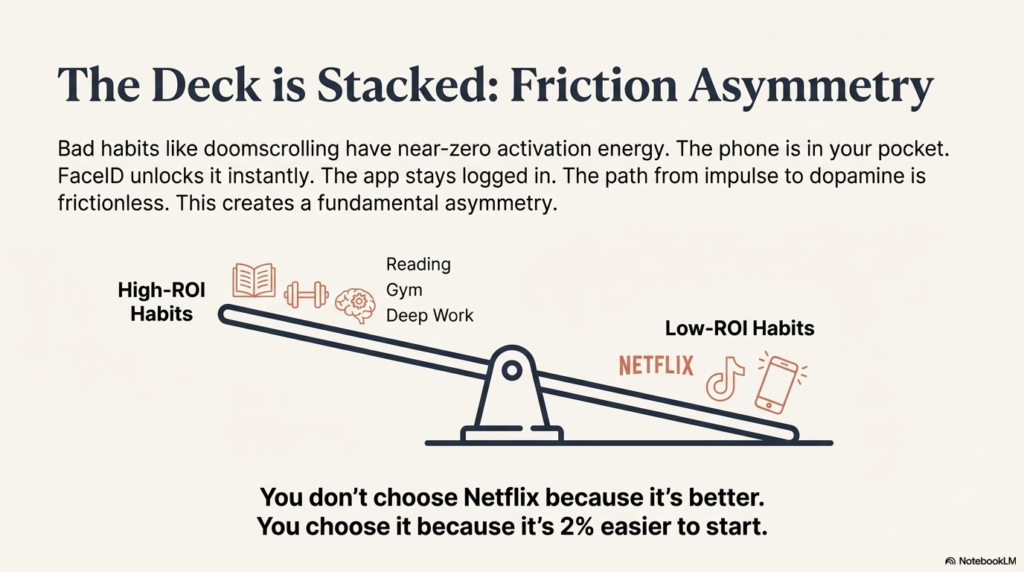
- High-ROI Habits (Reading, Gym, Deep Work): High activation energy.
- Low-ROI Habits (Netflix, TikTok): Zero activation energy.
You don’t choose Netflix because it’s better. You choose it because it’s 2% easier to start.
ALSO READ: The full execution container for making high-ROI habits the default: https://dewanshjain.com/the-3×3-system/
The 20-Second Rule: The Guitar Case Study

The most famous case study of this phenomenon comes from positive psychology researcher Shawn Achor. Achor wanted to practice guitar daily but failed consistently. He had the motivation; he lacked the mechanism.
He analyzed the friction: To play, he had to walk to the closet, undo the latches on the case, and take the guitar out. That process took about 20 seconds.
He made one change: He bought a $2 stand and placed the guitar in the middle of his living room.
The result? He practiced for 21 days straight.
By removing the 20 seconds of “setup friction,” he lowered the activation energy below the threshold of his willpower. He didn’t get more disciplined; he just made the good behavior the path of least resistance.
ALSO READ: Why tiny reps are the real unit of skill growth
Framework: The Friction Funnel
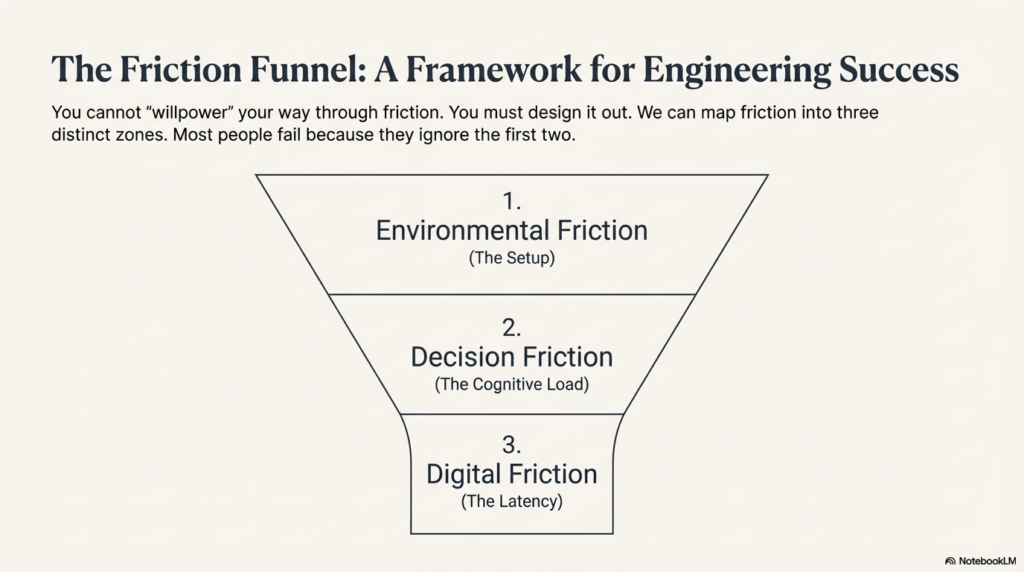
We can map friction into three distinct zones. Most people fail because they ignore the first two.
1. Environmental Friction (The Setup) This is the physical “sludge” in your way.
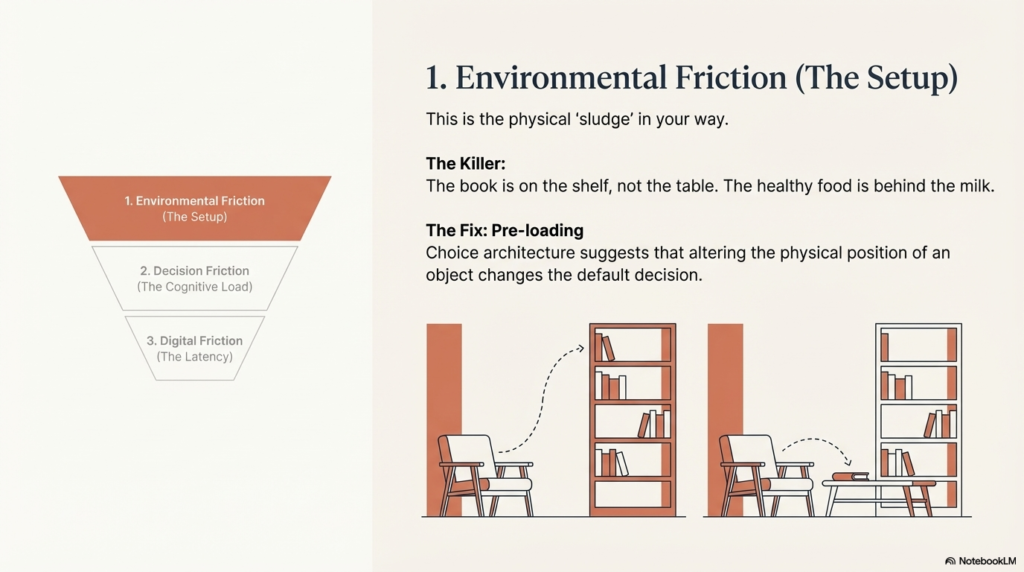
- The Killer: The book is on the shelf, not the table. The healthy food is behind the milk.
- The Fix: Pre-loading. Choice architecture suggests that altering the physical position of an object changes the default decision.
2. Decision Friction (The Cognitive Load) This is the mental energy required to figure out what to do.
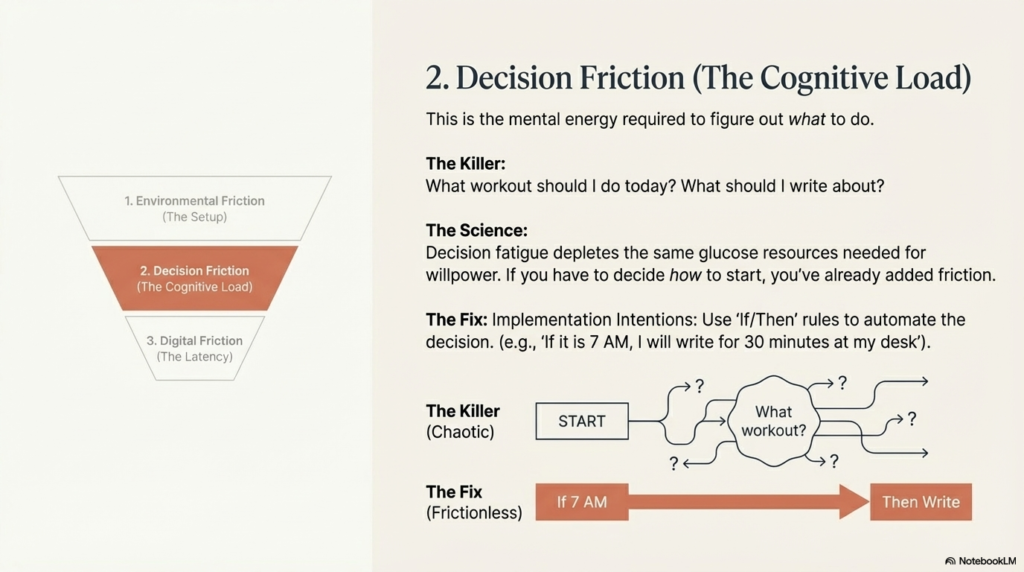
- The Killer: “What workout should I do today?” “What should I write about?”
- The Science: Decision fatigue depletes the same glucose resources needed for willpower. If you have to decide how to start, you’ve already added friction.
- The Fix: Implementation Intentions. Use “If/Then” rules (e.g., “If it is 7 AM, I will write for 30 minutes at my desk”) to automate the decision.
3. Digital Friction (The Latency) This is the 400ms Google delay applied to your tools.
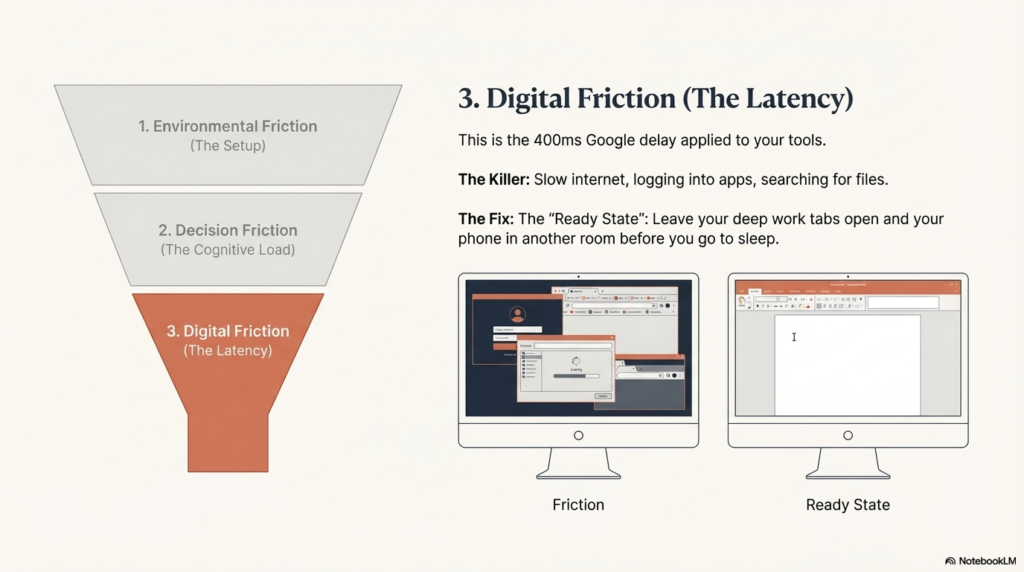
- The Killer: Slow internet, logging into apps, searching for files.
- The Fix: The “Ready State.” Leave your deep work tabs open and your phone in another room before you go to sleep.
Your Friction Audit: A Mini-Playbook
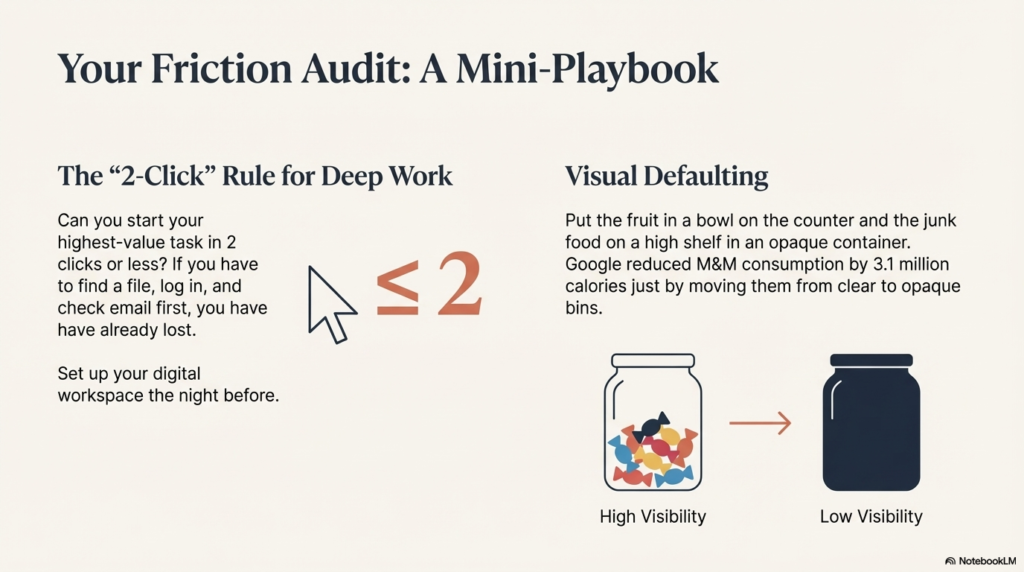
You cannot “willpower” your way through friction. You must design it out. Here is how to audit your life this week:
- The “2-Click” Rule for Deep Work: Can you start your highest-value task in 2 clicks or less? If you have to find a file, log in, and check email first, you have already lost. Set up your digital workspace the night before.
- Visual Defaulting: If you want to eat healthy, put the fruit in a bowl on the counter and the junk food on a high shelf in an opaque container. Google reduced M&M consumption by 3.1 million calories just by moving them from clear to opaque bins.
- The “Phone Foyer” Method: The ultimate friction removal for sleep and focus. Buy a charger for your kitchen (or foyer). Plug your phone in there. Buy a $10 alarm clock for your bedroom. You have now added “walking to another room” friction to your morning doomscroll.
Weaponizing Friction (Anti-Habits)
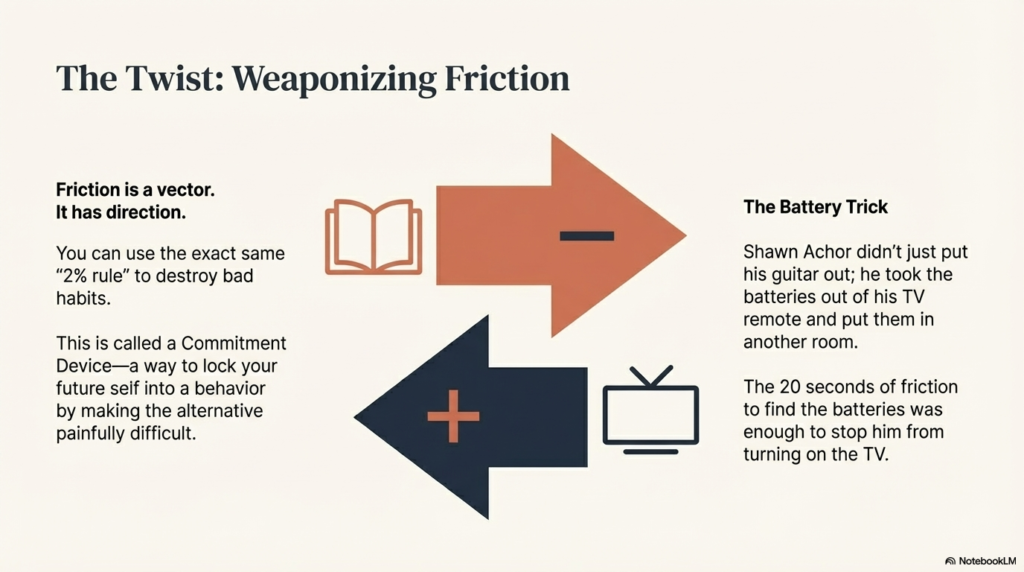
Here is the counter-intuitive twist: Friction is a vector. It has direction. You can use the exact same “2% rule” to destroy bad habits.
This is called a Commitment Device—a way to lock your future self into a behavior by making the alternative painfully difficult.
- The Battery Trick: Shawn Achor didn’t just put his guitar out; he took the batteries out of his TV remote and put them in another room. The 20 seconds of friction to find the batteries was enough to stop him from turning on the TV.
- Digital Shrapnel: Use apps like Freedom or Opal to block social media during deep work hours. You are artificially adding “latency” to the distraction. When the app blocks you, the Basal Ganglia realizes the “cost” of unlocking it is too high, and aborts the impulse.
ALSO READ: The long-term map of compounding practice, identity votes, and real mastery: https://dewanshjain.com/the-stages-of-mastery-ultimate-guide/
The Bottom Line
We tend to view our habits as a reflection of our character. “I am a lazy person.” “I am a hard worker.”
But often, we are just water flowing through pipes. If the pipe is clogged (friction), the water stops. If the pipe is clear, the water flows.
Stop trying to push the water. Fix the pipes.
Reduce the friction on the things that compound. Increase the friction on the things that decay. The difference between the version of you that succeeds and the version that fails isn’t usually a matter of fire in the belly. It’s a matter of 20 seconds.