

Note: This post was originally published in February 2025 but has been completely rewritten and expanded into a 10,000-word comprehensive guide as of December 7, 2025.
- Why You Feel Stupid When You Learn (And Why That’s Good)
- The Origin Story: It Wasn't Maslow
- The 4 Stages of Mastery: An Overview:
- Stage 1: Unconscious Incompetence (The "Ignorance" Phase)
- Key Features of Unconscious Incompetence
- The Trap: The Dunning-Kruger Peak ("Mount Stupid")
- The Neuroscience: Why Ignorance Feels Like Confidence
- Why Stage 1 Is So Dangerous
- How to Spot If You’re in Stage 1 (Brutal Honesty Check)
- The Goal of Stage 1 Is Not “Get Good” — It’s “Get Hit by Reality”
- Practical Exit Plan: How to Get Out of Stage 1
- Why This Stage Still Matters Later in Your Journey
- Bridge to Stage 2: Conscious Incompetence
- Stage 2 – Conscious Incompetence: (The "Struggle" Phase)
- Key Characteristics of Conscious Incompetence?
- What Stage 2 Feels Like from the Inside
- How Conscious Incompetence Shows Up in Real Skills
- The Neuroscience: Why Learning Hurts
- The Trap: The Talent Fallacy
- What Practice Should Look Like in Stage 2
- How to Know You’re Ready for Stage 3
- The Real Gift of Conscious Incompetence
- Stage 3: Conscious Competence (The "Grind" Phase)
- Stage 4: Unconscious Competence (The "Master" Phase)
- The Secret Level: The "Fifth" Stage and Cycles of Mastery
- How to Use the 4 Stages of Mastery to Design Your Practice (A Quick Framework)
- Conclusion: Fall in Love with the Plateau
- FAQs and Reflection Prompts, and Your Next Step in Mastery
- Where This Fits in Your Bigger Mastery System
Why You Feel Stupid When You Learn (And Why That’s Good)
There is a specific, agonizing frustration that hits every beginner.
You know what “good” looks like—you’ve read the great novels, watched the clean code tutorials, or seen the black belt spar. But when you try to do it yourself, the result is clumsy. It’s embarrassing.
Most people interpret this feeling as a lack of talent. They think, “I’m just not cut out for this,” and they quit.
They are wrong. To survive the learning process, you need to understand two things: The Gap (Psychology) and The Hardware (Biology).
1. The Psychology: “The Gap”
Ira Glass, the host of This American Life, famously gave this phenomenon a name: The Gap.
He argued that we get into creative work or skill acquisition because we have taste. But for the first few years, there is a chasm between your taste (which is killer) and your ability (which is disappointing).
You can see the quality you want, but your hands and brain can’t quite produce it yet.
2. The Biology: The Myelin Metamorphosis
If you look at the biology of learning, that feeling of clumsiness isn’t a sign of failure. It is a sign of neuroplasticity. It is the physical sensation of your brain attempting to bridge a chasm.
We tend to think of learning as a linear accumulation of facts—like filling a bucket with water. If that were true, learning would be smooth.
In reality, learning is a metamorphosis of the nervous system. You are not just adding software; you are upgrading your hardware. You are physically insulating neural circuits with myelin to turn slow, leaky electrical signals into high-speed superhighways.
3. The Map: The 4 Stages of Competence
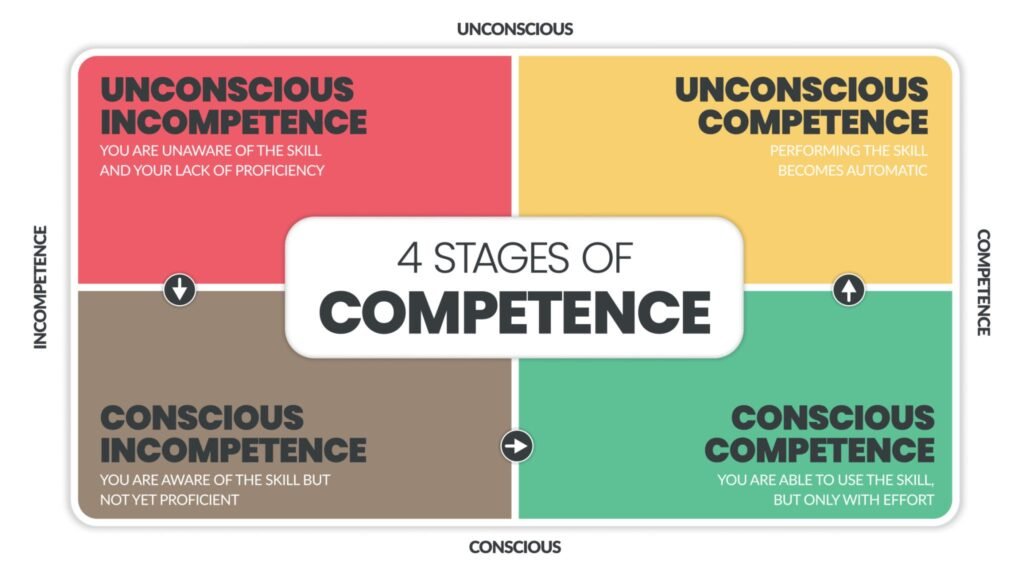
To survive this metamorphosis without losing your mind, you need a map.
That map is the Four Stages of Competence (aka The 4 Stages of Mastery).
This model explains the psychological and neurological terrain you must cross. It moves you from “blissful ignorance” to “painful awareness” and finally to “effortless mastery.”
Understanding this model changes the game because it allows you to diagnose exactly where you are in the lifecycle of a skill. Once you know your location, you can apply the right practice protocol to break through to the next level.
What We Will Explore
I recently wrote the “Stages of Mastery” cornerstone as the Grand Unified Theory—bringing together neurobiology, identity, and environment. This post is its sharp little sibling. It is zoomed in on one model and obsessed with one question:
“How do I actually use this to get better at my craft faster?”
In this post, we’ll cover:
- The Internal Experience: What each stage really feels like from the inside—your thoughts, emotions, and behaviors.
- The Neuroscience: What’s happening in your brain and attention span during each phase.
- The Protocols: What kind of practice actually works at each stage (and what completely backfires).
- The Big Picture: How the 4 Stages plug into bigger maps like Fitts–Posner, Dreyfus, and your identity as a “Writer,” “Coder,” or “Founder.”
Now, let’s start at the beginning: what this model really is, where it came from, and why it’s survived for 50+ years.
The Origin Story: It Wasn’t Maslow
Before we dive into the stages, a quick correction for the history books. If you Google this model, you will often see it called “Maslow’s Four Stages of Learning.”
Abraham Maslow gave us the Hierarchy of Needs (food, shelter, self-actualization). He did not give us the Four Stages.
The model first appeared in the 1970s work of Noel Burch, an employee of Gordon Training International, under the title “Four Stages for Learning Any New Skill.” It was designed to help adults learn leadership and interpersonal skills, but it turned out to be a universal framework for human competence—applying just as well to a Brazilian Jiu-Jitsu white belt as it does to a junior software developer.
The history tour is over, now let me walk you through the four phases of your brain’s evolution.
The 4 Stages of Mastery: An Overview:
Before you make any assumption of the stages, I want you to make things clear.
The Four Stages of Competence isn’t trying to measure:
- How advanced your technique is
- How deep your domain knowledge goes
- How complex your environment is
It’s mainly measuring the relationship between:
- Your actual competence, and
- Your conscious awareness of that competence.
And that’s what makes it so sticky:
- Stage 1 = Low skill, low awareness
- Stage 2 = Low skill, high awareness
- Stage 3 = Higher skill, high awareness
- Stage 4 = Higher skill, low awareness (because it’s automated)
So here’s the model placed on skills you actually care about today to give you more perspective before we dive deep:
- Writing
- Stage 1: You think “I’m good at writing” because you got school-topper marks.
- Stage 2: You read great essays and suddenly hate everything you’ve written.
- Stage 3: You can produce decent drafts on command, but it’s mentally heavy.
- Stage 4: You sit down and “just write,” shaping arguments and rhythm without overthinking the mechanics.
- Coding
- Stage 1: You think HTML = real programming.
- Stage 2: You touch real codebases and realise you know nothing.
- Stage 3: You can ship features, but you’re mentally exhausted by each one.
- Stage 4: You navigate systems, predict bugs, and refactor almost on instinct.
- Martial arts / combat sports
- Stage 1: You think “I’ll just swing harder.”
- Stage 2: First sparring session, you get wiped and realise timing, distance, and defence exist.
- Stage 3: You can execute combos if you concentrate.
- Stage 4: You read opponents, adapt mid-exchange, and your body “answers” without conscious planning.
- Content creation / entrepreneurship
- Stage 1: “I’ll just post consistently and everything will work out.”
- Stage 2: You see analytics, competition, and complexity; impostor syndrome spikes.
- Stage 3: You can plan campaigns, execute launches, and read numbers, but it’s still a mental marathon.
- Stage 4: You sense patterns in what works, make sharper bets, and design systems almost intuitively.
The key reframe: Unconscious competence is not the end of the journey; it’s where your unique style and expression finally have room to come out.
When your cognitive bandwidth is no longer consumed by “how do I do this?”, it frees up to ask “how do I want to do this?”
So yeah, now let’s zoom into Stage 1: Unconscious Incompetence. The deceptively comfortable place where most people’s dreams quietly go to die, and where a serious learner’s journey actually begins.
Stage 1: Unconscious Incompetence (The “Ignorance” Phase)
This is the stage of “Unknown Unknowns.” You don’t know what you’re doing, and worse, you don’t know that you don’t know.
Psychologists call this Unconscious Incompetence. The internet calls it the “Hold My Beer” phase.
This is Stage 1: Unconscious Incompetence–the “I’m fine, what’s the big deal?” phase. You’re unskilled and unaware, but you often feel oddly confident. That combo is lethal for growth and fantastic for denial.
If you’ve ever thought, “Writing? I’m good at writing, teachers always praised me,” or “I could totally start a business if I wanted to,” while doing… nothing about it — that’s Stage 1 energy.
Let’s break it down so you can actually spot it in yourself and others.
Key Features of Unconscious Incompetence
- Low skill, low awareness
- You underestimate complexity: “How hard can it be?”
- You overestimate your ability: “Give me a weekend and a YouTube playlist.”
- You don’t feel much pain yet, because the gap is invisible.
The paradox: the less you actually know, the more your brain fills in the blanks with stories about how capable you would be… if you bothered.
This is why the first encounter with reality later (Stage 2) feels so brutal: you go from casual confidence to “oh no” overnight.
The Trap: The Dunning-Kruger Peak (“Mount Stupid”)
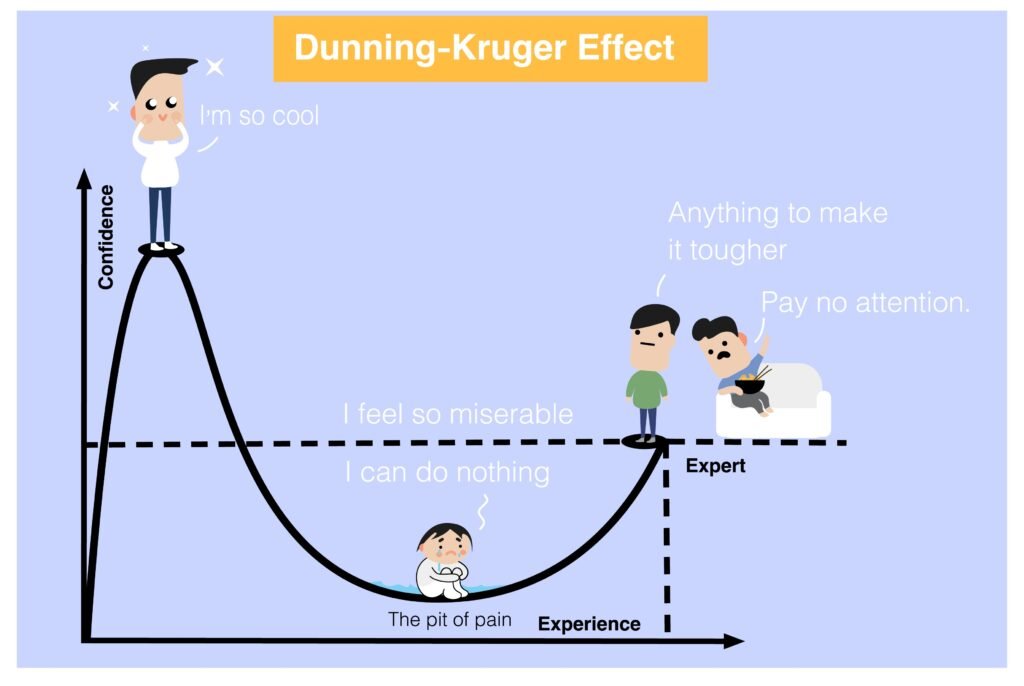
You cannot talk about Stage 1 without mentioning the Dunning-Kruger effect.
In their famous 1999 paper, psychologists David Dunning and Justin Kruger found a paradox: Poor performers are the least aware of their own incompetence.
Why? Because the skills required to be good at something (grammar, logic, humor) are the exact same skills required to evaluate if you are good at it. If you lack the skill, you also lack the ruler to measure the skill.
This leads to a spike in unearned confidence often called “Mount Stupid.” You aren’t arrogant; you are simply blind. You are operating with a low-resolution mental map that makes the territory look flat and easy to cross.
This stage is where the Dunning–Kruger effect lives: people with low skill but high confidence because they lack the knowledge to see their own gaps.
The Neuroscience: Why Ignorance Feels Like Confidence
Biologically, Stage 1 is quiet. Too quiet.
- Low Cognitive Load: Your Prefrontal Cortex isn’t working hard because it isn’t processing any errors.
- No Error Signal: The Anterior Cingulate Cortex (ACC)—the brain’s error-detection center—is silent. It only fires when an outcome violates an expectation. Since you expect to be “pretty good” and you haven’t actually tested yourself yet, your brain predicts success.
- Dopamine: You might even feel a hit of anticipatory dopamine. You are visualizing the result (winning the marathon) without simulating the friction (running mile 20).
Why Stage 1 Is So Dangerous
Stage 1 seems harmless but it quietly kills more dreams than “lack of talent” ever will.
Here’s why it’s dangerous:
- You don’t feel enough pain to act.
No feedback, no embarrassment, no data → no urgency. - You confuse knowledge about a skill with skill.
Consuming podcasts about startups ≠ actually building one. Reading writing tips ≠ putting 100,000 words into the world. - You build an identity without building evidence.
“I’m creative.” “I’m a good communicator.” “I’d crush it if I tried.”
These identities become fragile and hard to test, so you avoid real attempts that could disprove them. - You underestimate the cost of delay.
Every year you stay here, you don’t just “wait.” You lose compounded learning time you could’ve been stacking.
The real problem isn’t being bad; it’s being bad and unaware long enough that you never give yourself a chance to improve.
How to Spot If You’re in Stage 1 (Brutal Honesty Check)
Some questions to diagnose yourself:
- Have you actually practised this skill in the last 30 days? Or have you mainly thought/talked/read about it?
- Do you have any external feedback (coach, audience, paying users, peers) or only your own opinion?
- Can you point to concrete outputs?
- Written pieces published
- Features shipped
- Hours of sparring/training logged
- Products launched
If not, you’re probably overestimating where you stand.
Fast heuristic:
If your confidence is based on imagined potential rather than documented reps, you’re almost certainly in Unconscious Incompetence.
The Goal of Stage 1 Is Not “Get Good” — It’s “Get Hit by Reality”
Most people think the goal of Stage 1 is to magically leap to competence. It’s not.
The real goal:
Move from unconscious incompetence to conscious incompetence as quickly as possible.
In other words: turn your ignorance into clear, painful awareness.
You want to:
- Replace vague confidence with specific humility.
- Replace “I’ll be good at this” with “Here are 10 concrete things I can’t do yet.”
- Replace fantasy with first contact.
That sounds depressing, but it’s the opposite: once you see the gap, you can train it. Before that, you’re shadowboxing an imaginary opponent.
Practical Exit Plan: How to Get Out of Stage 1
Here’s how to deliberately break out of Unconscious Incompetence:
The Protocol: “The Cold Plunge”
- High-Speed Exposure: Don’t just read about the skill; watch the top 1% perform it. Watch a Grandmaster play chess; read the source code of a senior engineer. This builds the “Mental Representation” of what good actually looks like.
- The “Zero Draft” Attempt: Try to perform the skill immediately, with zero prep.
- Writing: Write a page.
- Coding: Try to solve a LeetCode easy problem.
- Music: Try to play along with a track.
- Record It: Record yourself or save your output.
- Seek External Mirrors, Not Just Internal Motivation
- Ask someone experienced to critique your work.
- Use objective metrics: response rates, engagement, accuracy, performance.
- Don’t argue; collect data.
- The Comparison: Put your attempt next to the Master’s.
- Write Down What You Can’t Do (Yet)
- Make a list: “Things I clearly can’t do but want to learn.”
- This list is the bridge to Stage 2 aka the shock your brain needs to enter Stage 2 and turn fuzzy incompetence into a roadmap.
Unconscious incompetence is not a sin. Staying there for years, with the same fantasies on loop, kind of is.
Why This Stage Still Matters Later in Your Journey
Here’s the twist: Stage 1 isn’t just a “beginner thing.” You revisit it every time you enter a new sub-skill:
- A “good writer” who’s a total beginner at sales pages.
- A “solid developer” who’s clueless at system design.
- A “black belt” who’s never coached beginners.
You’re multi-stage across sub-skills. Expert in one chunk, unconsciously incompetent in another. The danger is thinking your competence in one area automatically transfers to all others.
The pros difference:
- Beginners deny Stage 1.
- Masters look for it on purpose, because they know that’s where the next growth curve starts.
Bridge to Stage 2: Conscious Incompetence
Once you’ve taken those brutal first reps, comparisons, and critiques, you’ll feel it:
- The crash in confidence.
- The sudden awareness of complexity.
- The “I suck and this is overwhelming” wave.
That’s not failure. That’s you successfully exiting Stage 1.
In the next section, we’ll sit inside Stage 2: Conscious Incompetence: The emotionally painful but incredibly productive phase where mastery truly begins.
Stage 2 – Conscious Incompetence: (The “Struggle” Phase)
Welcome to the “Valley of Despair.” Stage 2 is where the fantasy dies and the real journey starts.
You finally try the thing “for real”—write the article, ship the feature, spar with a trained partner, launch the offer and suddenly your brain goes, “Oh. This is way harder than I thought. Also… I suck.”
Psychologists call this Conscious Incompetence. Seth Godin calls it “The Dip.”
This is Conscious Incompetence: you’re still bad, but now you know you’re bad. And that awareness hurts. It is where 90% of people quit because the dopamine hit of novelty has worn off, replaced by the crushing weight of reality. You are acutely aware of every mistake, every clumsy movement, and every gap in your knowledge.
Key Characteristics of Conscious Incompetence?
Conscious incompetence is the second stage of mastery where you’ve seen the true complexity of a skill, realised how limited your ability is, and become painfully aware of your gaps.
Key characteristics:
- Low skill, high awareness
- You can now see what “good” looks like — and you’re not there yet.
- Mistakes are visible and frequent.
- Confidence crashes faster than your actual ability changes.
What Stage 2 Feels Like from the Inside
The inner experience of Stage 2 is raw:
- Embarrassment – You watch back your own work and cringe.
- Overwhelm – “There’s so much to learn… where do I even start?”
- Self-comparison – You see how far ahead others are and feel like a fraud.
- Identity wobble – “Maybe I’m just not cut out for this.”
You’re no longer protected by ignorance. Every session gives you evidence of your limitations.
The paradox: you’re learning faster than ever, but it feels like you’re getting worse.
Why?
Because your taste and awareness are upgrading faster than your hands, words, or decisions can keep up. Your eye for quality moves ahead of your current ability to produce it. That gap = the pain of Stage 2.
How Conscious Incompetence Shows Up in Real Skills
Let’s zoom into a few domains.
Writing
- You start reading your favourite writers differently—their structure, pacing, clarity.
- You realise your own drafts are bloated, vague, or boring.
- Every editing session feels like “delete 70% and still not good enough.”
- Feedback from readers or editors stings because it’s accurate.
Coding
- You can make things work… but the code is messy, fragile, and hard to change.
- You copy from Stack Overflow but don’t really understand why it works.
- Code reviews expose naming issues, architecture flaws, missing tests.
- You realise how much you don’t know: data structures, testing, design patterns, performance.
Martial Arts / Fitness
- You spar and instantly see your timing, distance, and cardio are all off.
- You watch recordings and see your hands drop, your guard collapse, your footwork vanish.
- You’re constantly corrected on form; small tweaks change everything.
- The “I’m strong” identity collides with “I got handled by a smaller person.”
Entrepreneurship / Content
- You launch something… and it flops or underperforms.
- You see how shallow your market understanding actually is.
- You realise consistency, positioning, systems, and audience trust are brutally hard to build.
- You’re now aware of how many moving parts a “simple” business really has.
In Stage 2, the illusion of “I’d be good if I tried” is replaced by the evidence of “even when I try, I’m still far from good.” That’s a sacred moment if you let it be.
Basically, you’re standing at the border between two identities:
- Old identity (EGO): “I’m naturally good; I just haven’t started.”
- Emerging identity (alterEGO): “I’m a beginner; I have work to do.”
If you cling to the old identity, you’ll leave the skill. If you accept the new one, you’ll grow.
Stage 2 is where you choose between protecting your ego or building your future competence. You don’t get both.
The Neuroscience: Why Learning Hurts
What most people miss is that: This feeling of frustration is not a sign that you are failing. It is the only sign that you are learning.
So If you could look inside your brain during Stage 2, you wouldn’t see a smooth flow of information. You would see a chemical storm.
When you make a mistake—when you reach for a chord and miss, or write a sentence that falls flat—your brain detects a mismatch between prediction and reality. To alert you to this error, the locus coeruleus releases a flood of Norepinephrine (adrenaline).
Subjectively, high norepinephrine feels like agitation, anxiety, and frustration. It makes you want to get up and walk away. It feels like your brain is screaming, “Stop doing this!”
But biologically, this chemical agitation is the gatekeeper of neuroplasticity. It alerts your nervous system that the current neural map is insufficient and needs to be rewired. Norepinephrine tells the brain: “Don’t delete this session. Something important is happening. Pay attention.”
If you are not frustrated, you are not releasing norepinephrine. If you are not releasing norepinephrine, your brain is not rewiring. You are merely practicing what you already know.
The Trap: The Talent Fallacy
The trap here is interpreting this biological stress signal as a lack of talent.
We tell ourselves, “If I were meant to be a writer, this wouldn’t feel so hard.” This is false. The struggle doesn’t mean you lack potential; it means you are in the thick of the remodeling process. You are literally feeling the friction of your brain trying to build new connections.
To protect your EGO, you start:
- Chasing hacks instead of reps
- Bouncing between tutorials, books, and courses hoping to avoid the awkward practice phase.
- Comparing chapter 1 to someone else’s chapter 20
- Following elite performers closely and using them as proof you’ll never get there.
- Hiding your work
- Avoiding feedback to protect your ego, which also protects your incompetence.
- Overloading yourself
- Trying to improve everything at once, which melts your working memory and leaves you exhausted.
What Practice Should Look Like in Stage 2
Your goal in Stage 2 is not “mastery.” Your goal is survival. You need to keep your head above water long enough for the myelin to start forming. That why in Stage 2 how you practice starts to matter.
The Protocol: Embrace the Grind
- Shrink the Loop: Stop trying to perform the whole skill. You cannot “play the song.” You can only “play the third measure.” Break the skill down into micro-units (Deconstruction) that are small enough to manage.
- Hunt for Errors: Instead of avoiding mistakes, seek them out. Every time you spot an error, you get a small dopamine spike (the reward for detection), which counteracts the norepinephrine stress.
- Reframe the Feeling: When you feel that hot flush of agitation, say to yourself: “This is neuroplasticity. My brain is changing right now.”
Do not quit in the valley. The only way out is through.
How to Know You’re Ready for Stage 3
You don’t wake up one day and suddenly become “consciously competent.” It’s gradual, but some signals show you’re crossing the bridge:
- You can complete basic tasks reliably, even if slowly.
- You make fewer dumb mistakes and more interesting ones.
- You can explain what you’re doing and why, at least at a basic level.
- Feedback shifts from “this is all over the place” to “this part is solid, now tweak X and Y.”
- You leave sessions tired but proud, not just drained and ashamed.
You’re still highly aware of your limitations, but you’re starting to see specific things you do well, consistently.
That’s Stage 3 territory.
The Real Gift of Conscious Incompetence
It sounds dramatic, but Stage 2 is where you become a different kind of person:
- Someone who can tolerate being bad at something they care about.
- Someone who doesn’t confuse early struggle with permanent fate.
- Someone who trains their nervous system to stay in discomfort long enough for adaptation.
Once you’ve gone through Stage 2 consciously in one domain, you gain a meta-skill: you know what real learning feels like, and you stop panicking when it shows up again in new skills.
In the next section, we’ll explore Stage 3: Conscious Competence—the phase where you can finally perform well on command… as long as you stay laser-focused.
Stage 3: Conscious Competence (The “Grind” Phase)
You have survived the valley. You are no longer “bad.” You can do the thing—you can write the code, hit the serve, or structure the essay.
But my god, is it exhausting because it requires 100% of your available mental RAM.
Stage 3 is where things finally start to work.
This is the Conscious Competence: you can do the thing but only if you give it almost all your attention.
What Is Conscious Competence?
Conscious competence is the stage where you can perform a skill reliably and to a reasonable standard but it still requires deliberate focus, effort, and careful execution.
Key markers:
- Skill: moderate to high.
- Awareness: high.
- You know what you’re doing, but you can’t do it on autopilot.
- Distraction or fatigue can still cause your performance to collapse.
This is the first stage where you look competent from the outside, but it still feels fragile from the inside.
The Neuroscience of Stage 3: Why It Feels So Heavy
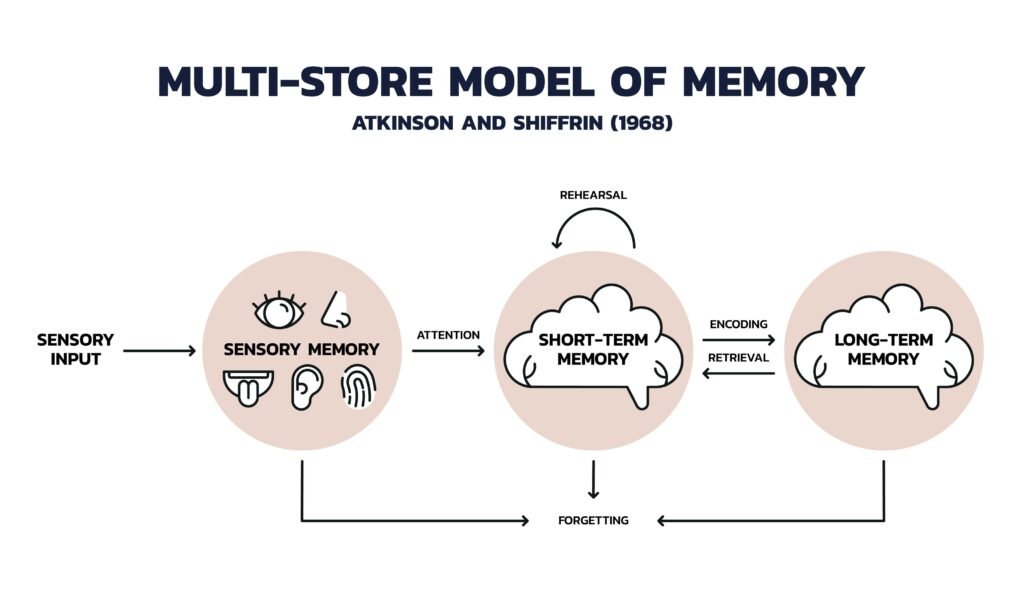
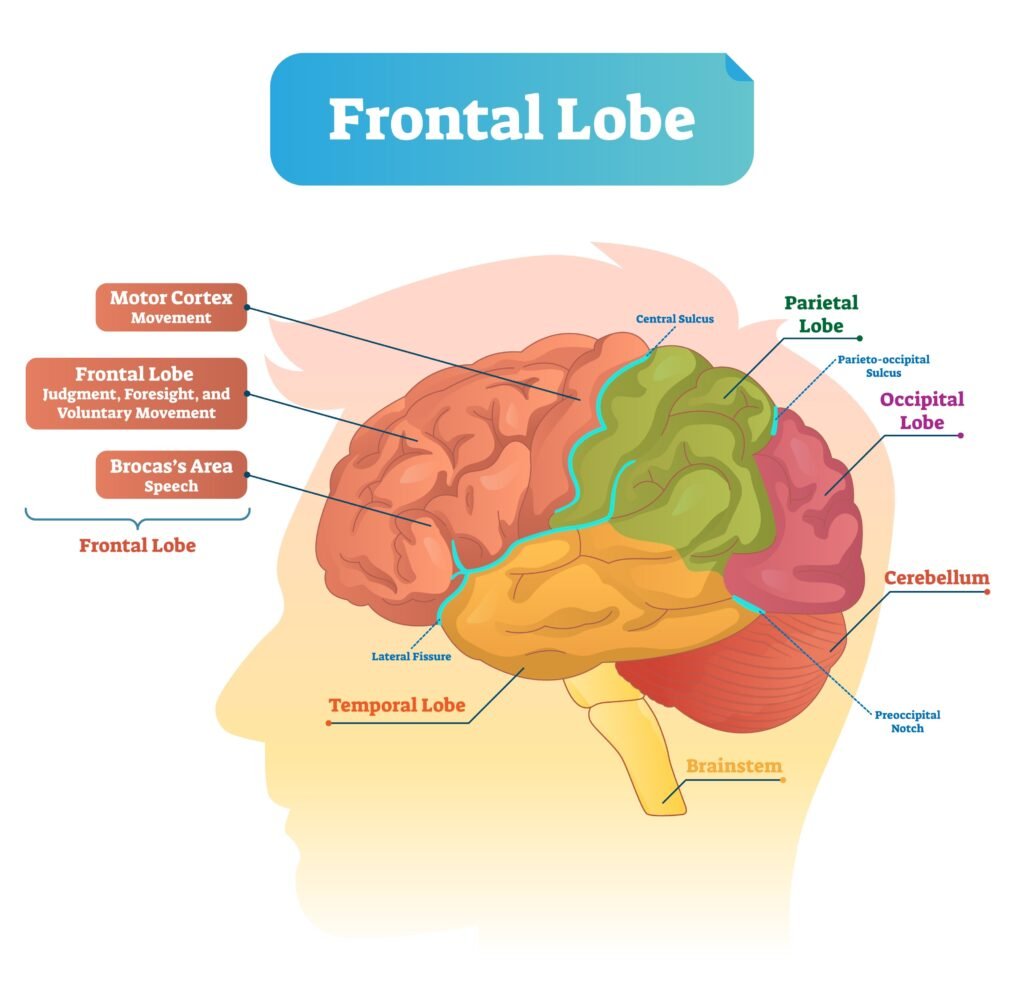
Biology explains why this stage feels like “heavy lifting.” Your brain is currently running the skill entirely through the Prefrontal Cortex (PFC).
The PFC is your conscious executive center. It is brilliant at solving new problems, but it is a metabolic battery hog with extremely limited bandwidth.
1. The Working Memory Bottleneck
Your working memory can only hold about 3 to 5 “chunks” of information at once. In Stage 3, you are using all those slots just to manage the mechanics of the skill.
- The Driving Analogy: Think back to learning to drive. You were “Consciously Competent.” You could drive the car, but you couldn’t listen to the radio.
- Your Brain: “Check mirror (Slot 1), signal (Slot 2), clutch (Slot 3), shift (Slot 4)… oh god, a pedestrian!”
- The Result: You are maxed out. If someone asks you a question while you are performing the skill, you have to stop the skill to answer. You don’t have the bandwidth for both.
2. The Energy Cost (The Glucose Burn)
Because you are driving the car with your conscious mind (PFC) rather than your subconscious autopilot (Basal Ganglia), you burn glucose rapidly.
This is why a 1-hour session in Stage 3 feels more draining than a 4-hour session in Stage 4. You are essentially sprinting a marathon mentally.
3. The Hardware Upgrade (Myelination)
While the software is running heavy, the hardware is frantically upgrading in the background.
- Myelination is Underway: Neural circuits you use often are being wrapped in myelin—a fatty sheath that insulates the nerve fibers.
- The “Patchy” Feeling: Unmyelinated signals are slow and leaky; myelinated signals are fast and efficient. In Stage 3, your myelination is patchy. This is why some parts of the skill feel smooth (insulated) while others still feel clunky (uninsulated).
The Summary: You are successfully “installing” expertise in real-time. The software is working, but the circuits haven’t fully hardened yet.
Conscious Competence in Real Skills
Let’s zoom into a few domains again.
Writing
- You can outline solidly and hit a clear structure.
- You know how to write an intro, build sections, and land a conclusion.
- You can fix most problems in your own drafts if you give yourself time.
- You’re not guessing anymore — you’re applying learned patterns.
But:
- If someone asks you to write “something different” on the spot, you still hesitate.
- Writing in a noisy café or under a tight deadline feels much harder.
- One bad draft can shake your confidence.
Coding
- You can build features end to end in your stack.
- You understand the major pieces of your codebase and how they fit together.
- Code reviews mark fewer “fundamental” mistakes and more “style” or “optimisation” feedback.
- You can debug most issues with a method, not pure guesswork.
But:
- New frameworks or patterns still throw you off.
- Under pressure, you might fall back to copy-paste or hacks.
- You can’t yet hold huge systems in your head; you still need diagrams, notes, or lots of comments.
Martial Arts / Performance
- You can execute combos with correct form at moderate speed.
- You see openings and can occasionally capitalise on them.
- You’re no longer terrified in sparring or on stage — but nerves still show up in your body.
- In ideal conditions, you look good.
But:
- Under fatigue, technique breaks down.
- A stronger or trickier opponent can send you back into Stage 2 panic.
- You still think a lot during performance — “step, guard, breathe, throw…”
Entrepreneurship / Content
- You can consistently ship content, offers, or campaigns that perform decently.
- You understand positioning, basic funnels, and your audience fairly well.
- You’re capable of planning and executing projects without constant chaos.
- You see repeatable patterns in what works for your brand or business.
But:
- You still have to think through every decision carefully.
- Complex markets, big campaigns, or multiple moving pieces can overload you.
- You know enough to see how far you still are from true leverage.
Stage 3 is where you start to act like a practitioner, not a tourist.
The Trap of Stage 3: The “OK” Plateau
This is the most subtle and dangerous trap in the entire learning lifecycle.
Because the agonizing pain of Stage 2 is gone, and you are now “good enough” to get by, the brain’s evolutionary hunger for efficiency kicks in. It whispers: “We did it. We are safe. Let’s stop burning energy.”
You stop struggling. You stop failing. You enter what science writer Joshua Foer calls the “OK Plateau.”
You become a “decent driver,” a “competent typist,” or an “intermediate Spanish speaker”—and you stay there for the next 20 years. You have ceased to improve because you have ceased to be uncomfortable.
5 Signs You Are Stuck on the Plateau
If you feel like your progress has flatlined, you have likely fallen into one of these specific Stage 3 traps:
1. The Template Trap (Rigidity)
- The Behavior: You’ve found scripts, code snippets, or content structures that work, so you follow them rigidly every time.
- The Cost: This keeps you safe, but it blocks the experimentation required for Stage 4 intuition. You are painting by numbers, not creating art.
2. Perfectionism Paralysis
- The Behavior: Because you finally know what “good” looks like, you refuse to publish or ship anything that doesn’t match your internal standard.
- The Cost: You ship less volume. Since learning is a function of iteration, your growth rate slows down.
3. The Performance Trap (All Work, No Practice)
- The Behavior: You spend 100% of your time “doing the thing” (client work, writing articles, sparring) and 0% of your time on Deliberate Practice.
- The Cost: You get better at coping with your current skill level, but you don’t actually raise the ceiling of your ability.
4. Environmental Stagnation
- The Behavior: You stay where you feel competent—the same gym partners, the same tech stack, the same kind of clients.
- The Cost: You are protecting your ego rather than stretching your nervous system. You cannot grow in an environment you have already mastered.
5. The False Summit
- The Behavior: Because you can produce decent results consistently, you assume you’re close to the end.
- The Cost: You mistake Reliability for Mastery. You haven’t reached the peak; you’ve just reached Base Camp.
You have ceased to improve because you have ceased to be uncomfortable. That is how “mid-level” careers are born.
What Practice Should Look Like in Stage 3
To escape Stage 3 and reach mastery, you must do something counter-intuitive: You must artificially re-introduce the struggle.
You need to make the task harder than it needs to be. Cognitive psychologist Robert Bjork calls these “Desirable Difficulties.”
If your practice feels smooth, you are just polishing your mediocrity. To break the plateau, you need to shock the system. Here is the 5-step protocol for Stage 3 practice.
1. Shift from “More Reps” to “Constraint Training”
In Stage 2, you needed repetition to learn the basics. In Stage 3, repetition is a trap. You need quality-controlled, constraint-driven practice.
You must force your brain to adapt to new variables by restricting your options.
- Writing: Don’t just “write.” Write under strict time limits, in a new tone, or with a max word count of 300.
- Coding: Don’t just “build.” Refactor old code, force yourself to write the test before the function, or rebuild a module without using a specific library.
- Martial Arts: Start from a disadvantageous position (e.g., someone on your back) or spar using only your left hand.
2. Use Interleaved Practice (Stop doing A-A-A)
Most people practice in “Blocks”: Skill A, Skill A, Skill A. This is comfortable because your brain keeps the solution in short-term memory.
You need to switch to Interleaved Practice: Skill A, Skill C, Skill B, Skill A.
- The Mechanism: By mixing up the skills, you force your brain to “reload” the solution from long-term memory every single time.
- The Result: It feels harder and you might perform worse in the session (the “wobble”), but your long-term retention skyrockets.
3. Upgrade Your Feedback Loop
In Stage 3, binary feedback (“Good” or “Bad”) is useless. You need High-Fidelity Feedback.
- Nuance: Look for timing, precision, economy of motion, and structure.
- Data: Where possible, use objective metrics.
- Writers: Click-through rates, retention time.
- Coders: Runtime speed, error rates, cyclomatic complexity.
- The Ideal Combo: Self-Review (Video/Logs) + Expert Review (Mentor) + Objective Metrics (Data).
4. The “Teaching” Accelerator
Nothing exposes the gaps in your Conscious Competence like trying to explain it to a beginner.
- The Serializing Effect: To teach, you have to take the parallel processing happening in your brain and “serialize” it into a linear explanation. This forces you to clarify your own thinking.
- The Fraud Factor: You will occasionally feel like a fraud. That’s okay. Teaching is the fastest way to debug your own knowledge.
5. Protect Deep Work Windows
You cannot multitask your way to Stage 4. The neural compilation required to move from “Conscious” to “Unconscious” requires heavy focus.
- Block off time for High-Focus Practice.
- Block off time for System-Level Thinking (Architecture, Strategy).
Your goal at Stage 3: build reliability + flexibility. You want to be able to do the thing well, in more conditions, with less drama.
How to Know You’re Edging Toward Stage 4
You don’t flip a switch from “conscious” to “unconscious” competence. But these are signs you’re entering Stage 4 territory in parts of your skill:
- You can perform while doing something else:
- Holding a conversation while driving.
- Teaching while writing on a whiteboard.
- Debugging under pressure in a live setting.
- You experience more frequent “I just did that without thinking” moments.
- You can improvise within the skill — not just execute learned patterns.
- People start asking you how you did something… and you struggle to fully explain every micro-step.
- You feel more boredom than terror when doing the basics.
You might be Stage 4 in some sub-skills and Stage 3 (or even 2) in others. That’s normal.
The Real Value of Stage 3
Stage 3 is where you become legitimately useful:
- You can contribute meaningfully to teams, audiences, and clients.
- You can deliver on promises, not just experiment.
- You can choose to improve instead of being forced to improve just to survive.
Most real-world value is created by people who are between Stage 3 and early Stage 4 in a cluster of skills not by mythical, fully “mastered everything” wizards.
If you treat Stage 3 as the end, you’ll stagnate.
If you treat Stage 3 as the launchpad to deeper mastery, you’ll start playing a very different game.
In the next section, we’ll explore Stage 4: Unconscious Competence—the stage where your skill becomes second nature… and why that’s not the end of the story, but the beginning of a new set of risks and responsibilities.
Stage 4: Unconscious Competence (The “Master” Phase)
Stage 4 is where everything finally looks easy.
This is the state where the skill has migrated out of your conscious mind and settled deep into your nervous system.
You’re writing and sentences just… fall into place.
You’re sparring and your body slips, counters, and angles without a running commentary in your head.
You’re coding and your fingers type out patterns before you consciously recall the docs.
People call it “talent”. Psychologists call this Unconscious Competence. Athletes call it Flow. The Taoists call it Wu-Wei (effortless action).
In this stage, the gap between thought and action disappears. You have closed the gap.
What Is Unconscious Competence?
Unconscious competence is the stage where a skill has become automatic and effortless. You can perform it reliably, often even under pressure, without needing to consciously think through each step.
Core markers:
- Execution is fast and fluent.
- Attention is free to focus on strategy, creativity, or other people.
- You often struggle to fully explain every micro-step of what you’re doing.
- Mistakes still happen, but they feel like glitches in an otherwise smooth pattern, not signs that you’re faking it.
- People ask you for help or guidance in that area by default and you’re often more bored than scared by the basics.
This is the “muscle memory” stage but the name undersells what’s actually going on.
Unconscious competence isn’t the end of learning; it’s the point where learning and performing finally separate into two different modes.
The Neuroscience of Stage 4: The Hardware Upgrade
Why does Stage 4 feel so different? Because you are literally thinking with a different part of your brain.
In Stages 1 through 3, you were running the software on your Prefrontal Cortex (PFC)—the slow, energy-expensive “conscious executive.”
In Stage 4, the brain realizes this pattern is permanent, so it offloads the task to the Basal Ganglia and the Cerebellum—the brain’s ancient, efficient automation centers.
Here is what is happening inside your brain to create that feeling of “Mastery”:
1. The Physical Insulation (Thick Myelin)
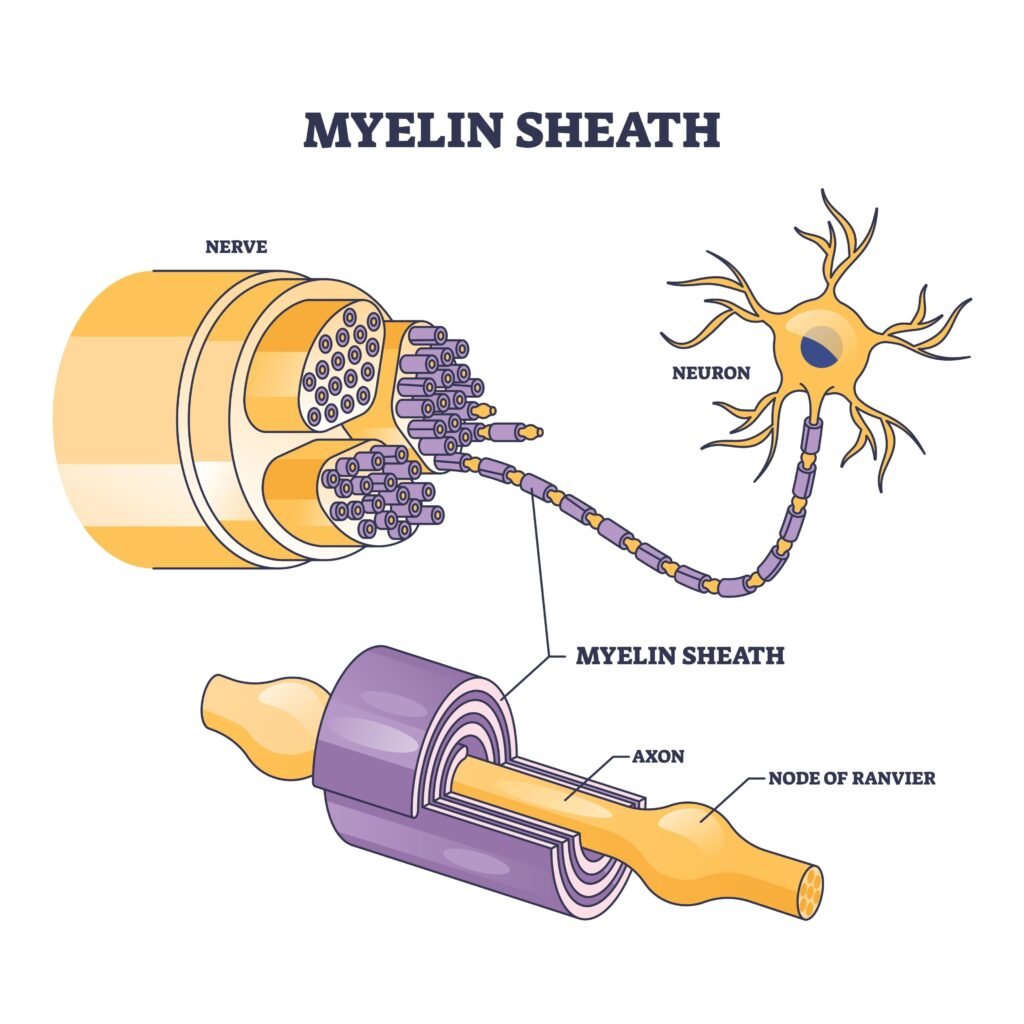
The axons in your most-used neural circuits are now heavily wrapped in myelin—a fatty sheath that acts like electrical tape.
- The Result: Signals travel up to 100x faster than in untrained circuits.
- The Feeling: This raw speed is what we call “intuition.” You are no longer thinking; you are conducting electricity efficiently.
2. The Speed Differential (300ms vs 20ms)
Because the signal has moved from the slow “conscious” track to the fast “automated” track, your reaction time plummets.
- Conscious Processing (PFC): Takes about 300–500 milliseconds.
- Unconscious Processing (Basal Ganglia): Takes about 10–20 milliseconds.
- The Result: You are now reacting faster than you can think. By the time you consciously realize a mistake has happened, your hands have already fixed it.
3. The “Flow” State (Transient Hypofrontality)
This is the neurological definition of Flow.
- Hypo (Low) + Frontality (Prefrontal Cortex): The “thinking brain” actually quiets down.
- The Silence: The inner critic goes silent because the PFC is temporarily deactivated to save energy. You stop self-monitoring and start performing.
4. “Matrix Vision” (Chunking)
You stop seeing isolated details and start seeing patterns.
- The Novice Sees: A pawn, a knight, a bishop. (Separate elements).
- The Master Sees: A “Sicilian Defense” or a “Weak King Side.” (A whole scene).
- Whether it’s a chess board, a line of code, or a jiu-jitsu grip, the master processes the data as a single chunk, freeing up mental bandwidth for strategy.
At Stage 4, “intuition” is just your nervous system running a bunch of pre-computed simulations faster than your conscious mind can narrate them.
This is why explaining your skill to a beginner suddenly feels weirdly hard (lol).
Unconscious Competence in Real Skills
Let’s ground this in domains again.
Writing
- You can draft clean, coherent prose at speed.
- You “hear” when a sentence is off before you can say why.
- You adjust tone and pacing almost automatically for different formats (Twitter thread, long-form blog, email).
- Editing feels like sculpting, not surgery.
Coding
- You can design and implement systems with fewer dead ends.
- You recognise bug patterns instantly: “this smells like a race condition / null issue / off-by-one.”
- You navigate large codebases without getting lost; you have a mental map.
- You write idiomatic code in your language without consciously thinking about syntax.
Martial Arts / Performance
- You see openings and counters as if they’re highlighted.
- You adjust distance, timing, and rhythm in real time.
- You can “flow roll” or improvise on stage without freezing.
- Your body maintains form even under fatigue or pressure.
Entrepreneurship / Content
- You can sniff out bad offers, weak positioning, or broken funnels quickly.
- You sense what a market will likely respond to before the data arrives.
- You adjust strategies mid-launch based on live signals.
- Content topics, hooks, and structures come to you without forcing it.
Stage 4 makes your skill feel like an extra sense: you don’t think about “using it”. It’s just how you perceive and respond to the world.
The Hidden Risks of Stage 4: Why Mastery is Dangerous
You might think Stage 4 is the finish line. It is not. It is a new kind of trap.
Unconscious Competence is both a superpower and a curse. It allows you to perform without effort, but it also blinds you to how you are performing. Here are the four hidden risks of mastery.
1. The Expert Blind Spot (The “Source Code” Problem)
Have you ever tried to learn from a natural genius, and they just said, “I don’t know, just feel it”?
This is the Expert Blind Spot. Because your skill is now unconscious, you have lost access to the “source code” of how you do it. You are running the program, but you can no longer read the script.
- The Consequence: You literally cannot explain your own magic. This makes you a terrible teacher and limits your ability to debug your own errors when things go wrong.
2. Fossilization (The “Myelin” Problem)
Myelin is great for speed, but it is terrible for flexibility. Once a skill is automated, it resists change. The brain wraps the circuit in insulation, essentially “freezing” that behavior in place.
- The Consequence: If you automated a bad habit (like a poor golf swing or messy coding syntax), it is now encased in myelin.
- The Fix: Fixing a fossilized error requires Unlearning. You have to drag the skill back up to Stage 3 (Conscious Attention), which feels incredibly painful and regressive.
3. Identity Lock-In (The Ego Problem)
When your identity fuses with your skill, your ego becomes fragile. You start saying: “I’m a Senior Engineer,” “I’m a Black Belt,” or “I’m a best-selling author.”
- The Consequence: You stop taking risks. You unconsciously avoid any experiment that might make you look like a beginner again. You protect your image instead of your growth.
4. The Return of the “OK” Plateau
Once a skill feels effortless and “good enough” to solve your real-world problems, your brain has every biological reason to stop optimizing.
- Your code stays solid but rarely innovative.
- Your business works but doesn’t evolve.
- Your training maintains your level but doesn’t push it.
The Insight: The OK Plateau is what happens when your nervous system decides that “good enough” is cheaper than “getting better.”
What Practice Should Look Like at Stage 4
If Stage 3 practice is about sharpening competence, Stage 4 practice is about preventing drift and opening new dimensions.
Once a skill is automated, the brain stops paying attention to it. To keep growing, you must force your brain out of comfort and back into plasticity.
Here are the 5 principles of Stage 4 Practice:
1. Deliberately Break Autopilot You must pick specific micro-skills and drag them back into conscious practice. You are essentially choosing to be a beginner again for 20 minutes.
- Writing: Don’t just write; experiment with a genre you hate.
- Coding: Don’t just solve the problem; solve it using a new paradigm or a language you don’t know well.
- Martial Arts: Switch your stance. If you are a striker, force yourself to grapple.
2. High-Stakes Simulations (The “Stretch” Zone) Put yourself in environments where your current autopilot is almost not enough. The goal isn’t reckless risk, but stretch.
- Spar against harder opponents.
- Pitch to bigger clients.
- Commit to a live demo without a safety net.
3. Focus on Nuance and Elegance At Stage 4, raw “correctness” is no longer the frontier. The frontier is Beauty.
- Don’t just ask: “Did it work?”
- Ask: “How can I do the same thing with less effort, less noise, and more speed?”
The Metric: Efficiency and Emotional Control.
4. Build “Second Brain” Systems Start exporting your intuition into external assets.
- Turn your “gut feeling” into Checklists, Frameworks, and Playbooks.
- Why? This prevents regression under stress and creates assets that allow others to accelerate through the earlier stages.
5. Train Adjacent Skills Stop grinding the same narrow groove. Widen your impact by developing the skills around your craft.
- Learn the Strategy behind the code.
- Learn the Psychology behind the sale.
- Learn the Storytelling behind the data.
The Secret Level: The “Fifth” Stage and Cycles of Mastery
If the model is called the Four Stages of Competence… what on earth is “Stage 5”?
There is a final concept that isn’t in the original 1970s model, but modern neurobiology suggests it is essential. It is called Reflective Competence.
You’ve probably met people who are clearly experts, but they’re not just good at the thing — they can also explain it, fix it when it breaks, coach others through it, and redesign how it’s learned. They’re not only performing the skill; they’re holding the whole skill in their hands and turning it around like an object.
That’s what this “hidden stage” is about.
Stage 5 isn’t about doing the skill better; it’s about seeing the skill clearly enough to teach, redesign, and restart the game on purpose.
To stay a Master, you cannot just stay in Stage 4 (Flow). You must oscillate between Flow (Stage 4) and Analysis (Stage 3).
At Stage 5, you can:
- Name what your intuition is actually doing.
You notice patterns in your decisions, your timing, your choices — and turn those into language, diagrams, checklists. - Toggle between autopilot and analysis.
You can perform fluidly, then replay a moment in slow motion and break it into steps: “Here’s why I did X, then Y.” - Design learning environments.
You don’t just run drills — you design drills for other people (or for your future self) that target specific sub-skills. - Map stages for others.
You can see where someone is stuck in the 4-stage loop and give them the right kind of practice and feedback.
This is what solves the expert blind spot:
- Stage 4 experts often struggle to teach because everything is intuitive.
- Stage 5 masters regain access to the beginner’s world — not emotionally (they’re not stuck there), but structurally.
- They build stage-aware scaffolding: “If you’re here, do this next.”
In Stage 5, you turn your hard-earned intuition into transferable assets.
The Fractal Nature of Mastery: Restarting the Loop at New Levels
Here’s the twist: Reflective competence doesn’t replace the four stages. It sits on top of them AND restarts them.
Think of mastery as fractal:
- At one level, you’ve reached Stage 4 in execution (e.g., writing clean code).
- Then your career shifts: now you’re a Senior Engineer or Tech Lead.
- Suddenly you’re asked to:
- Architect systems.
- Mentor junior devs.
- Negotiate with product and stakeholders.
Guess what?
At this new level of complexity, you’re back at:
- Unconscious Incompetence (Stage 1) about architecture, leadership, or negotiation.
- You don’t even know what you don’t know yet.
You’ve hit a new loop of mastery, nested inside the old one.
Same happens in every domain:
- A writer becomes an editor or teacher of writing.
- A martial artist becomes a coach or gym owner.
- A freelancer becomes a studio owner or agency lead.
- A content creator becomes a creative director or education brand.
On the old axis (execution of the original skill), you might be Stage 4 or 5.
On the new axis (leading, teaching, system-building), you’re back at Stage 1–2.
Mastery doesn’t move in a straight line; it unfolds like a spiral. Each time you level up, you’re a beginner again, just at a higher altitude.
This is the fractal nature of mastery:
- Every time you climb one ladder, you discover another ladder attached to it.
- Each ladder runs through the same 4 stages:
- Don’t know you suck.
- Know you suck.
- Can do it with effort.
- Just do it.
- And if you choose, Stage 5:
- Can see, explain, and redesign the whole ladder.
How to Practically Step into Reflective Competence (Stage 5)
You don’t have to wait until you’re a world-class grandmaster to tap into Stage 5. You can start building Reflective Competence as soon as you hit a solid Stage 3 or 4 in any sub-skill.
Here are 5 entry ramps to start the cycle:
1. The “One Step Back” Rule (Teach) You don’t need to be a guru; you just need to be one step ahead.
- The Action: If you are at Conscious Competence (Stage 3), mentor the Stage 2 folks. If you are early Stage 4, mentor Stage 3s.
- The Neuroscience: Teaching is the ultimate hack. It forces you to take your implicit, unconscious feelings (Basal Ganglia) and translate them back into explicit, conscious words (Prefrontal Cortex). You understand why you are good, not just that you are good.
2. Codify Your Intuition (Name Your Patterns) Unconscious competence is silent. Reflective competence is verbal.
- The Action: When you spot recurring moves or mistakes in your work, give them sticky names.
- Writing: “The Lazy Paragraph” or “The Panic Hook.”
- Coding: “The Hero Refactor” or “The Spaghetti Loop.”
- The Result: Naming a pattern gives you power over it. You turn a vague feeling into a checklist item.
3. The Decision Journal Don’t just log what you did; log why you did it.
- The Action: After a performance (a sales call, a coding sprint, a sparring session), ask: “Why did I choose that approach? What signal was I reacting to?”
- The Result: Over time, these notes become your personal playbook—a “Second Brain” for your craft.
4. Shift from “Worker” to “Architect” Most people just do the drills. The master designs the drills.
- The Action: Identify a specific weak link in your game (e.g., transitions in video editing, guard retention in BJJ).
- The Drill: Build a custom 10–15 minute drill that targets only that weak link.
- The Result: You stop being a passive consumer of training and become the architect of your own progress.
5. Build “Stage Maps”
- The Action: Roughly sketch what Stage 1, 2, 3, and 4 look like in your specific domain. What are the emotional markers? What are the rookie errors?
- The Result: You’ve just created your first framework. You are no longer just playing the game; you are seeing the matrix.
The Truth: The Master loves the plateau, but they do not sleep there.
How to Use the 4 Stages of Mastery to Design Your Practice (A Quick Framework)
The most common question people ask is: “Okay, but where am I?”
It is easy to misdiagnose yourself. Imposter Syndrome can make a Stage 3 Expert feel like a Stage 2 Beginner. Conversely, the Dunning-Kruger effect can make a Stage 1 Novice feel like a Stage 4 Master.
Use this simple heuristic framework to cut through the noise. Ask yourself three questions:
1. The “Talk Test” (Cognitive Load)
- Can I hold a conversation while doing this task?
- No: You are in Stage 2 or Stage 3. Your Prefrontal Cortex is fully occupied.
- Yes: You are in Stage 4. Your Basal Ganglia has taken over.
2. The “Error Timing” Test (Awareness)
- When do I realize I made a mistake?
- I don’t: Stage 1 (Unconscious Incompetence).
- Immediately after I do it: Stage 2 (Conscious Incompetence).
- While I am doing it: Stage 3 (Conscious Competence).
- Before I do it: Stage 4 (Unconscious Competence).
3. The “Feeling” Test (Emotion)
- What is the dominant emotion?
- Excitement / Naivety: Stage 1.
- Frustration / Anxiety: Stage 2.
- Exhaustion / Focus: Stage 3.
- Boredom / Flow: Stage 4.
The Diagnostic Matrix
| Stage | Can You Talk? | Error Detection | Dominant Feeling | Practice Goal |
|---|---|---|---|---|
| 1. Unconscious Incompetence | Yes (delusionally) | None | Bliss / Excitement | Wake Up (See Reality) |
| 2. Conscious Incompetence | No | After the fact | Frustration / Shame | Survive (Reps + Safety) |
| 3. Conscious Competence | No | During the act | Mental Fatigue | Refine (Variance) |
| 4. Unconscious Competence | Yes | Predictive | Flow / Boredom | Disrupt (New Constraints) |
Conclusion: Fall in Love with the Plateau
We live in a culture that fetishizes the highlight reel. We see the guitarist shredding on stage, the founder ringing the IPO bell, and the black belt flowing through a kata. We see the Unconscious Competence.
We rarely see the years spent in the humiliating, clumsy, exhausting trenches of Conscious Incompetence.
Because we don’t see the struggle, we misunderstand it. We think that if learning feels hard, we must be doing it wrong. We think that if we hit a plateau, we have failed.
This model offers a different truth: The struggle is the point.
If you are comfortable, you are not learning. You are just remembering.
Your Call to Action
Don’t just read this article and nod. Turn this map into a tool.
- Pick One Skill: Choose the one project or hobby that has been stalling.
- Diagnose Your Stage: Use the checklist above. Are you a deluded novice (Stage 1), a frustrated struggler (Stage 2), or a bored intermediate (Stage 3)?
- Change Your Method for One Week:
- If Stage 2: Stop trying to be perfect. Do more reps in private.
- If Stage 3: Stop enjoying your competency. Make it ugly again.
- If Stage 4: Teach it to someone else.
Mastery is not a destination. It is simply the habit of falling in love with the plateau, over and over again.
FAQs and Reflection Prompts, and Your Next Step in Mastery
We’ve gone from the simple 4-box diagram to the messy reality underneath it: biology, emotion, identity, and practice design. Let’s land this plane and turn the model into something you actually use this week.
Reflection Prompts: Turning the Model into Action
You’ll get the most out of this article if you actually write with it. Try these prompts in your journal or notes app:
- Pick one skill that matters this year.
- What skill is it? (e.g., writing, coding, sales, martial arts, content).
- Why does it matter now?
- Diagnose your stage honestly.
- For that skill as a whole, which stage are you in right now?
- For its key sub-skills (e.g., idea generation, editing, publishing), what stage are you in for each?
- Design one stage-aware practice block.
- If you’re Stage 2: What’s one tiny drill you can repeat 20–50 times this week?
- If you’re Stage 3: How can you add variability or constraints to your next 3 sessions?
- If you’re Stage 4: Which micro-skill will you deliberately “deconstruct” and rebuild?
- Emotional check-in.
- What is the dominant emotion you feel when practising this skill: excitement, shame, boredom, quiet confidence?
- What does that emotion suggest about your stage?
- Next-month nudge.
- If the only goal for the next 30 days was “move one stage forward or deepen this stage,” what would change in your calendar?
A model becomes powerful the moment it starts changing what’s on your calendar, not just what’s in your head.
Quick FAQs on the 4 Stages of Mastery
Q1. What are the 4 stages of mastery in simple terms?
The Four Stages of Competence describe how your awareness of your skill changes as you learn:
- Unconscious Incompetence – You don’t know what you don’t know.
- Conscious Incompetence – You realise how much you suck.
- Conscious Competence – You can do it, but only with full focus.
- Unconscious Competence – You “just do it” on autopilot.
It’s less a personality label and more a zoomed-out view of your learning experience over time.
Q2. How do I know which stage I’m in?
Ignore vibes. Look at behaviour:
- If you underestimate the skill and mostly fantasise → Stage 1.
- If you practise and see constant mistakes → Stage 2.
- If you can perform decently but need full focus → Stage 3.
- If you can perform smoothly and explain it only after the fact → Stage 4.
If in doubt, assume you’re one stage lower than your ego wants. That assumption alone will improve your practice.
Q3. Can I be in different stages for the same skill?
Yes, constantly.
You might be:
- Stage 4 at basic guitar chords but Stage 1 at improvisation.
- Stage 3 at writing blog posts but Stage 1 at writing sales pages.
- Stage 4 at coding features but Stage 2 at architecture decisions.
Think in sub-skills, not “I am Stage X forever.”
Q4. Can I skip stages if I use a coach, course, or AI?
You can move through stages faster, but you can’t skip the underlying biology: focused struggle, errors, and rewiring.
Coaches, good courses, and AI feedback:
- Reduce wasted reps.
- Shorten how long you stay stuck.
- Help you avoid building the wrong patterns.
But they don’t remove the need to feel stupid, frustrated, and challenged. That’s the price of entry for a new level.
Tools can compress time, but they can’t delete discomfort.
Q5. Why does it sometimes feel like I’m getting worse even after months of practice?
That’s often a good sign.
As you move from naive repetition to more deliberate practice:
- You see more of your mistakes.
- You start changing your technique.
- Your performance temporarily dips while your brain reorganises its internal model.
Think of it as renovating a house: things look messier right before they look better.
Where This Fits in Your Bigger Mastery System
You’ve just zoomed in on one of the cleanest, most memorable maps in the skill-acquisition world: the 4 Stages of Mastery.
Here’s how it plugs into the larger universe:
- Use the 4 Stages of Competence to name your subjective experience of learning: how skilled you are and how that feels.
- Use models like Fitts–Posner and the biology of mastery to understand what’s happening in your brain and body as you move from effortful thinking to automatic flow.
- Use models like Dreyfus to map your evolution as a professional: how your judgement, pattern recognition, and responsibility grow over time.
- Use your own custom stage maps (which we built in the bigger “Stages of Mastery” pillar) to describe what each phase looks like in your specific domain.
If this article was the “entry map”, the larger Stages of Mastery guide is the full atlas:
- How neurochemistry, myelin, and cognitive load shape your progress.
- How identity, environment, and feedback loops change across stages.
- How to design a long-term, stage-aware system for a whole life of skills, not just one.
You don’t have to master all of that today.
For now, if you walk away with just three things, let them be:
- You are not “bad”; you’re at a stage.
- Every stage has a matching practice style.
- Your job is not to jump to Stage 4; it’s to move one honest stage at a time.
Close this tab, pick one skill, diagnose your stage, and design one tiny stage-aware session for this week.
That’s how mastery always starts: not with a grand declaration, but with one deliberate rep that wasn’t random.