
Why We Think Our Situation Is Special and Blind Ourselves to Reality
Narcissism: Where a person becomes obsessed with their own importance and needs constant praise to feel stable. People with high levels of narcissism often believe they are superior to everyone else. They might brag constantly, expect special treatment, or get very angry if they aren’t the center of attention.
There is a quiet form of narcissism that almost no one talks about.
It is not the narcissism of vanity. Not the narcissism of mirrors, applause, status, or self-advertisement. It is subtler than that. Smarter. More respectable. More dangerous.
It is the narcissism of believing that your current situation is uniquely complicated, uniquely painful, uniquely exceptional, and therefore somehow exempt from the patterns that govern everyone else’s life.
That is what I want to call The Narcissism of the Present.
It is the strange human tendency to stand in the middle of our current problem and assume that the normal rules do not apply to us.
We become convinced that our case is special.
- Our struggle is deeper.
- Our context is more nuanced.
- Our obstacles are more complex.
- Our timeline is different.
- Our emotional state is different.
- Our destiny is different.
And because of that, we stop seeing clearly.
We do not want our current pain to be ordinary because ordinary pain feels small. If our struggle belongs to a repeating human pattern, then maybe it is not proof of our special depth. Maybe it is simply the cost of being human.
That can feel insulting to the ego. But it is also the trap that keeps us stuck.
The Most Dangerous Lie We Tell Ourselves
The lie sounds harmless:
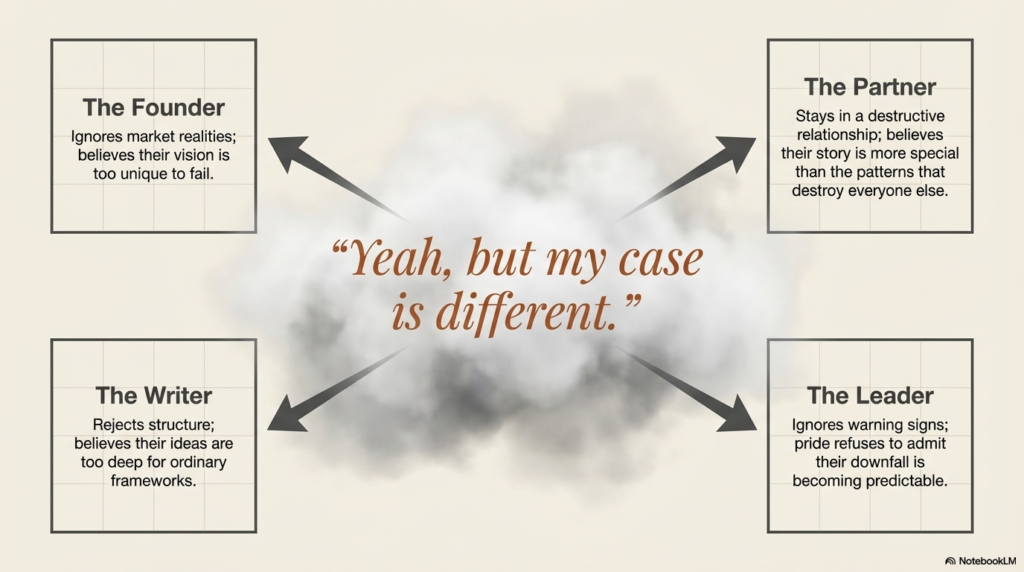
“Yeah, but my case is different.”
That sentence has ruined projects, relationships, businesses, health goals, and entire years of human life. It sounds like nuance, but often it is just ego wearing the mask of sophistication. You see it everywhere.
- A founder ignores market realities because they believe their vision is too unique to fail.
- A person stays in a destructive relationship because they believe their story is more special than the patterns that destroy everyone else.
- A writer rejects structure because they think their ideas are too deep for ordinary frameworks.
- A leader ignores obvious warning signs because pride refuses to admit that their downfall is becoming predictable.
The tragedy is that this bias rarely feels like bias. It feels like intelligence. It feels like “understanding the complexity.”
The present moment has a way of intoxicating us. It magnifies everything. And because we are so close to the experience, we mistake proximity for truth.
The Prison of Particulars (Where Kahneman Meets Parrish)
To understand why we do this, we have to look at where two powerful ideas from two brilliant thinkers collide.
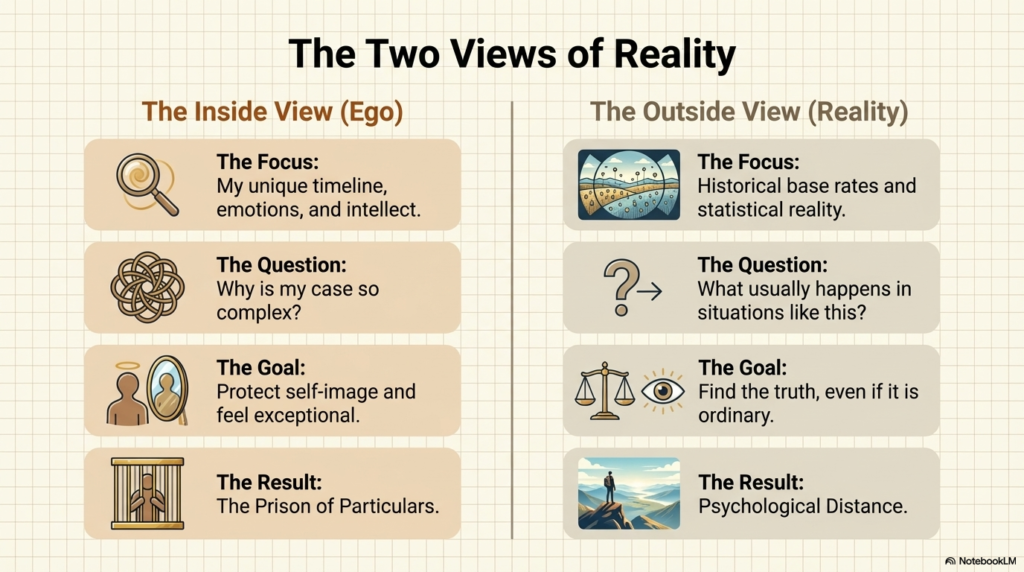
Daniel Kahneman talks about the inside view: our tendency to focus on the specific details of our own case (my timeline, my emotions, my intelligence) while ignoring the broader statistical reality of how such situations usually unfold.
The outside view, on the other hand, asks a colder question: What usually happens in situations like this? It looks at base rates and history. It does not care how special we feel.
Basically we assume we are the exception until reality reminds us that we are participants, not exemptions.
The outside view is humbling because it drags us out of the theatre of our own mind and places us back into the statistics of being human.
And the ego hates that.
The EGO Default
Then comes Shane Parrish, who talks about the ego default: the part of us that filters reality through self-image, pride, status, and identity. Once ego enters the picture, thinking is no longer about truth.
It becomes about self-protection. You are no longer asking “What is real?” You are asking “What version of reality allows me to keep feeling like myself?”
When you put these together, you get the exact mechanism behind the Narcissism of the Present.
The inside view tells us, “Look closely at your specific situation.”
The ego default whispers, “And remember, your situation is special.”
We cling to the inside view because our ego needs our present moment to feel exceptional. If the outside view suggests your plan is unrealistic or your behavior is predictable, it feels insulting. The ego would often rather lose with dignity than win with humility.
Vagabond and Psychological Distance
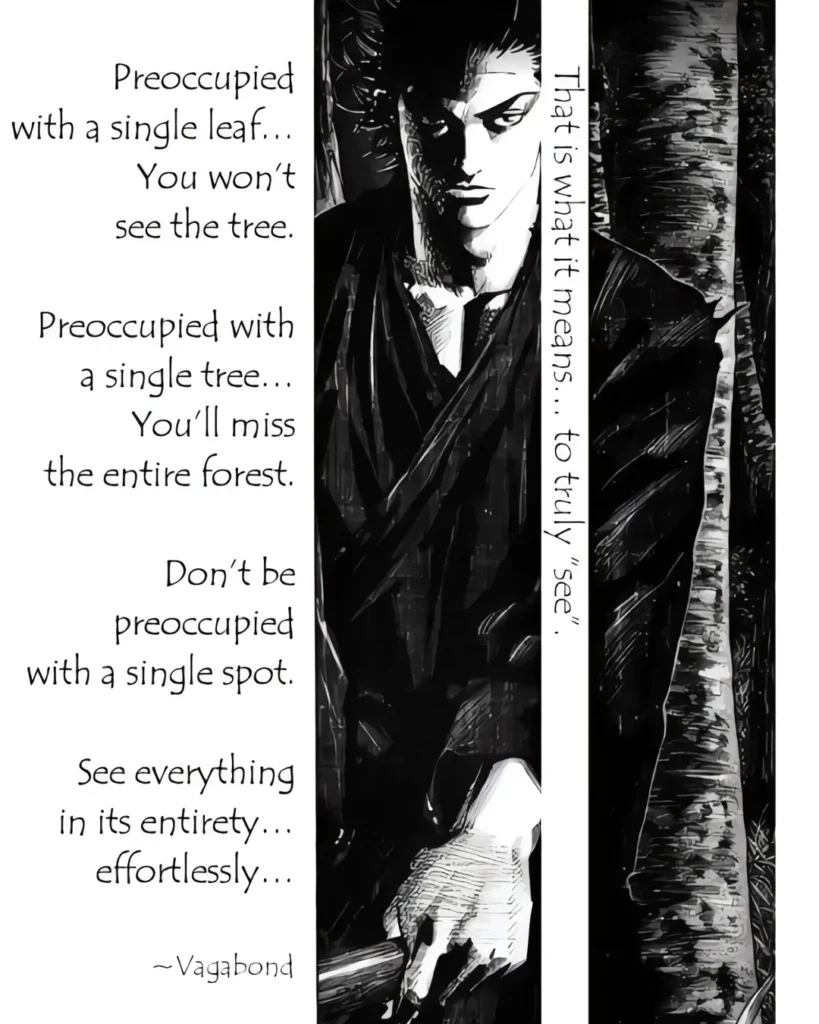
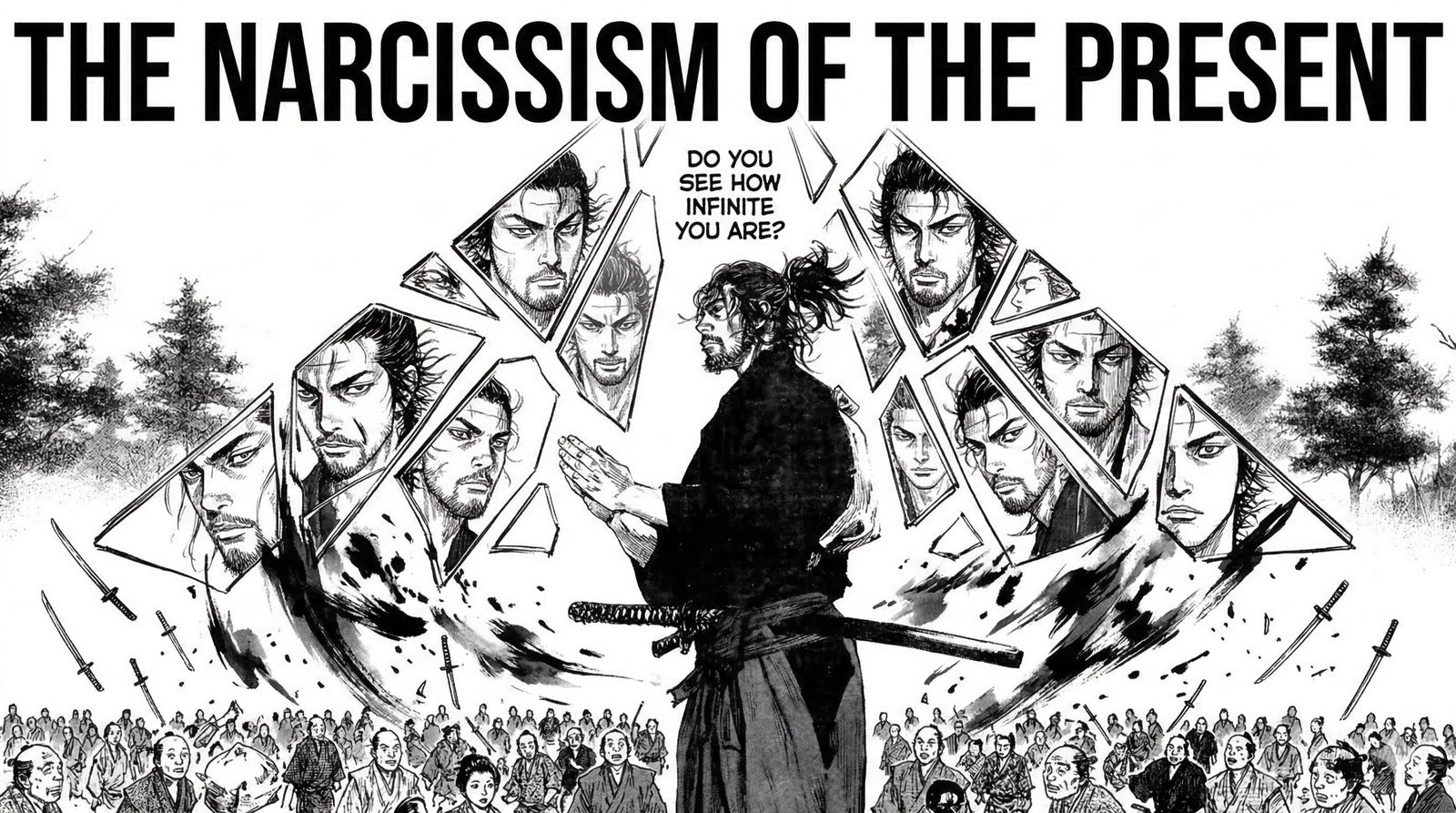
One of the best artistic illustrations of this idea appears in the manga: Vagabond.
Musashi is not merely learning how to swing a sword faster. He is learning how to see. Again and again, he gets consumed by the heat of the duel, by his ambition, by his identity as a warrior.
In those moments, his awareness collapses. He becomes too close to the battle. He notices the sword in front of his face, but he loses the rhythm of the fight.
This is exactly how Psychological Distance Theory works.
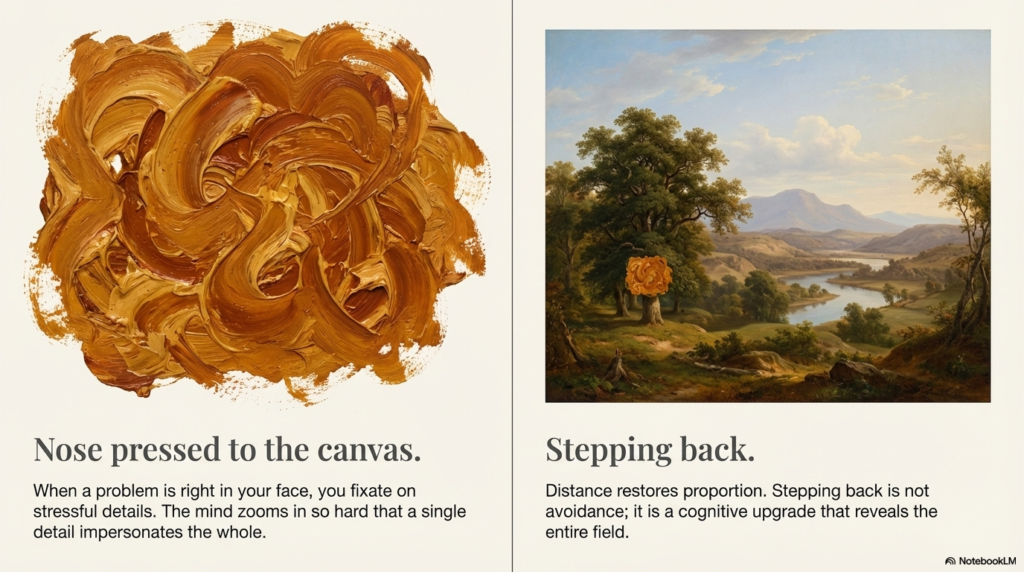
Imagine standing with your nose pressed against a painting. All you can see are messy strokes, blobs of color, fragments that do not make sense. When a problem is right in your face, you fixate on stressful details.
You obsess over one difficult question, one setback, one threat. Your mind zooms in so hard that the detail starts impersonating the whole.
But step back a few feet, and suddenly the painting reveals itself.
Distance restores proportion. In Vagabond, the wise mentors push Musashi toward wider perception. Because to truly see the battle, he has to relax his grip on the point and expand his awareness to the whole field.
Stepping back is not avoidance. It is a cognitive upgrade. Psychological distance turns a giant wall into a hurdle on a longer road.
It stops you from asking, “What is hurting me right now?” and makes you ask, “What is this an instance of?”
When you are too close to the problem, you do not see the problem.
My Own Experience With This Trap
What makes this concept feel real to me is that I have already lived it many times before I had the name for it.
One of the clearest examples came when I started writing and publishing content.
There were times when posts took up to four to six weeks to finish. In my mind, that delay seemed justified. I told myself the ideas were deep. The structure had to emerge naturally. The work needed more internal wrestling.
But that was largely the inside view talking.
Once I stepped back and used objective frameworks, the fog started to clear. The problem was not that my ideas were too profound for structure. The problem was that I was trapped in self-expression without enough attention to communication.
When you are immersed in your own ideas, it is easy to mistake emotional closeness for intellectual depth. The ego wants to say, “My process is unique.” Reality often says, “No, you just need a framework.”
I had to learn to build a ‘glass’ to hold my creative ‘water’—a concept I explored deeply in my breakdown of becoming a Professional Amateur.
Ravana and The Intelligence Trap
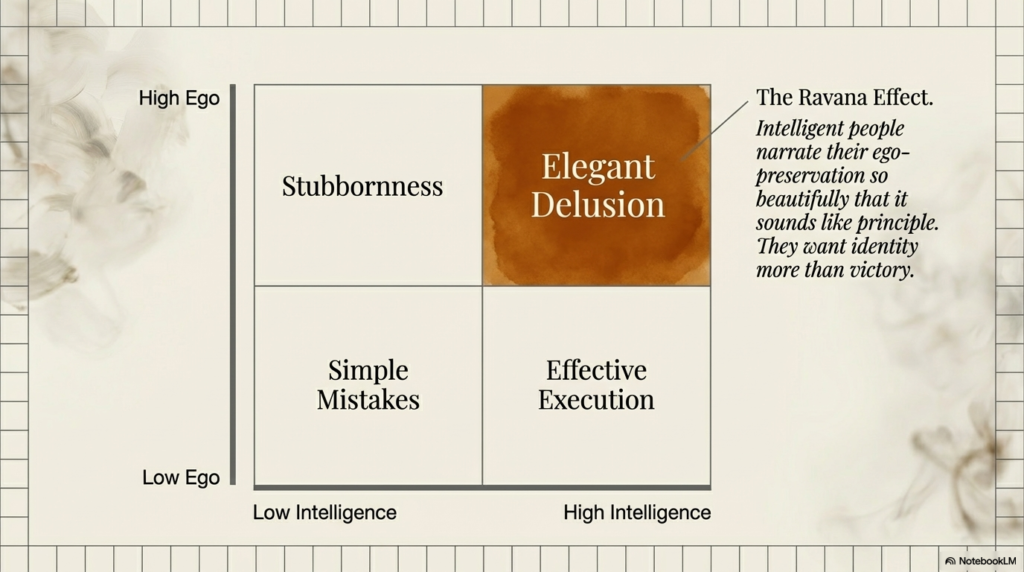
This pattern appears in mythology because it is one of the oldest human errors. Ravana is one of the clearest examples of the ego default in action.
He was not foolish in the ordinary sense. He had the ultimate knowledge, power, and brilliance. On some level, he knew his downfall was approaching. And yet he continued. Why?
Because the ego does not only want victory. It wants identity.
Ravana would rather remain Ravana than become the man who bowed to truth. He had to believe his story would somehow transcend the usual laws.
This illustrates the ultimate danger: smart people are often not protected from this bias. They are often better equipped to justify it.
A less intelligent person may simply be wrong. An intelligent person can be wrong with architecture.
They can build elegant explanations for why their case is different. They can generate complexity where simplicity would have saved them. They narrate their ego-preservation so beautifully that it starts sounding like principle.
Reality has no respect for self-mythology. The more tightly you cling to a grand image of yourself, the harder it becomes to see the simple truth standing in front of you.
How to Escape the Narcissism of the Present
The solution is not to erase individuality. It is to kill self-flattering distortion. You do not need to become cold. You need to become honest.
Step 1: Start with One Brutal Question
How many people have been in a situation like this before me?
Usually, the answer is a lot. That question punctures the illusion of specialness.
Step 2: Force The Outside View
Ask:
- What usually happens here?
- What do the base rates say?
- What would I predict if this were happening to someone else?
- What pattern am I refusing to see because I am too emotionally inside it?
Step 3: Create Psychological Distance
Zoom out in time.
Zoom out in identity.
Zoom out in emotion.
Zoom out in narrative.
Imagine advising a friend with the same problem. Imagine viewing today from six months in the future. Imagine seeing your struggle not as a unique curse but as a chapter in a pattern-filled human life.
Distance does not weaken clarity. It often creates it.
One of the most effective ways to manufacture this distance is to stop acting as your ‘stressed self’ and start operating through a different lens—a process I call building an alterEGO to bypass your default identity.”
Step 4: Watch Out For “Ego” Language
Whenever you hear yourself saying:
“My case is different.”
“Normal advice won’t work for me.”
“This has to be harder because my situation is unique.”
Pause. Maybe that is insight. But maybe that is ego trying to preserve the drama of exceptionality.
Step 5: See The Pattern, Then Execute
Pause for 5 to 10 seconds and take a deep breath.
First, see the pattern. Then bring your individuality to it.
Truth first. Style second. Reality first. Identity second. That sequence matters.
The Great Reframe (The Final Insight)
The most useful replacement thought I know is this:
My situation is not unique in structure. It is only unique in texture.
That sentence preserves individuality without sacrificing truth. Yes, your life has its own texture. Your relationships, wounds, timing, and ambitions are yours. But the structure beneath it is ancient.
- You are not the first person to overestimate a plan.
- You are not the first person to mistake ego for conviction.
- You are not the first person to get trapped inside a problem.
We want our present struggle to be special because we think that makes us important. But the more desperately we insist on our exceptionality, the longer we stay trapped in the same old human loops.
The breakthrough comes when we stop saying, “My case is different,” and start saying, “My case is a version of something humanity has seen before.”
That is not the death of individuality. It is the death of delusion.
And maybe that is where clear thinking really begins. It begins with the willingness to admit that your current moment, however intense it feels, is not a sacred exception to reality. It is a human moment.
The moment you stop being narcissistic about the present, you finally become capable of shaping the future.