

How to Write an Article From 8 Notes (With a 1,000-Word Example)
Turn scattered highlights, fleeting thoughts, and permanent notes into one clear article using only eight usable ideas.
What is an article? It’s simply a collection of connected thoughts.
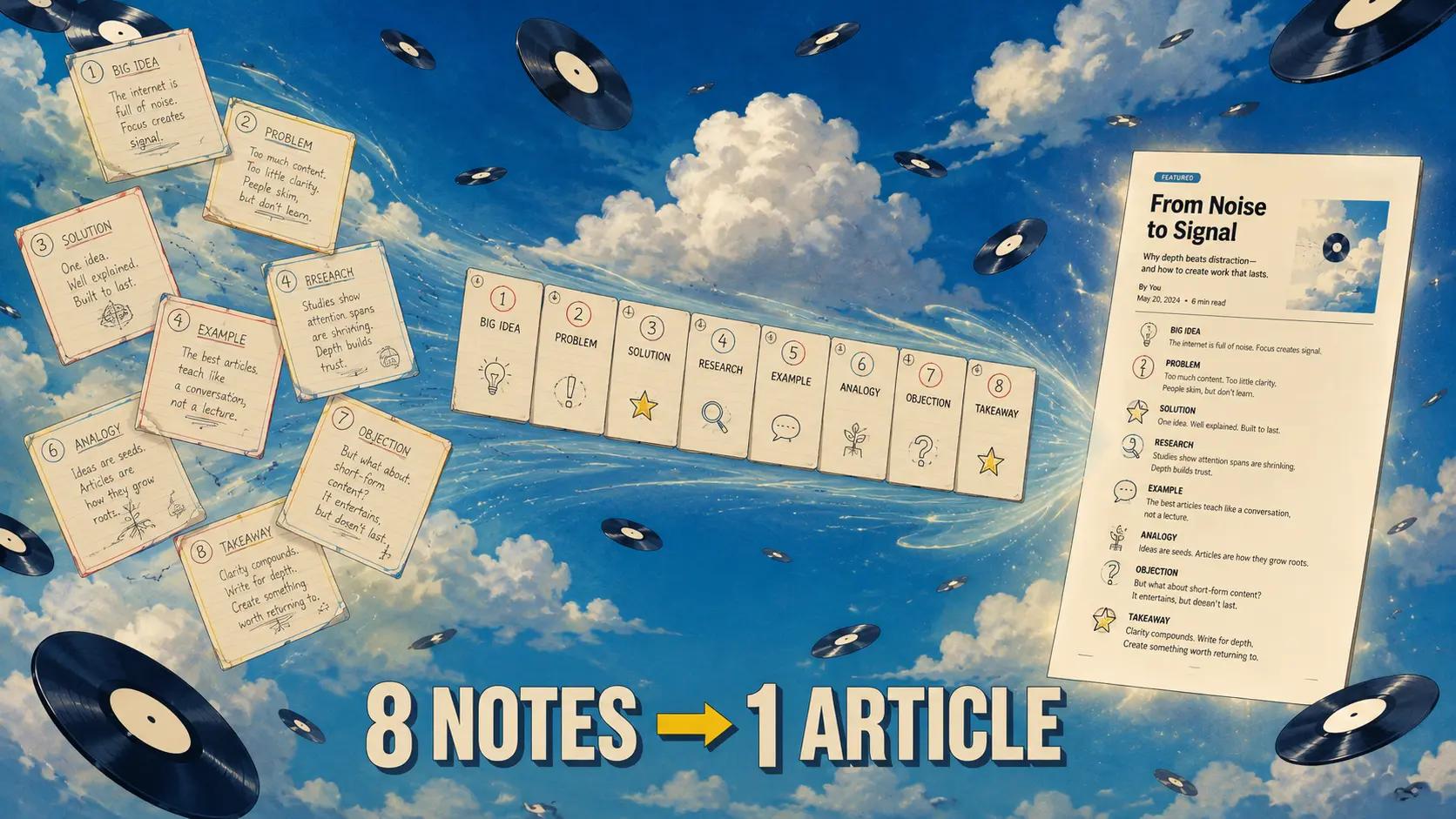
This article began as eight notes.
Not eight pages of research. Not eighty highlights. Eight clear thoughts I could explain, connect, and expand.
I am going to show you how to write an article from notes by turning those eight thoughts into one coherent argument. Near the end, I will reveal the actual notes behind this article so you can see how a handful of separate thoughts became the piece you are reading now.
Because a 1,000-word article is not one enormous piece of writing.
It is approximately eight clear thoughts arranged into an argument and expanded.
Once you see writing that way, the blank page stops asking you to invent 1,000 words. It gives you a much smaller job: find the thoughts, decide how they belong together, and build.
VERY IMPORTANT:
The number (8 notes) isn’t the lesson. The lesson is that articles are built from modular ideas.
Sometimes an article needs: 5 notes, sometimes 15, sometimes 40. 8 simply happens to be enough surprisingly often.
Why 1,000 words feels harder than it is
Writing advice often makes 1,000 words sound like a major expedition. You need weeks of research, a perfect outline, a completely original argument, and enough expertise to defend a doctoral thesis in the comments.
So you open a blank document, look at the word counter sitting at zero, and feel the distance between where you are and where you think a “real writer” should be.
Then you do the most understandable thing possible.
You consume more.
You read another book. Watch another video. Save another post. Add another twenty highlights to the pile. It feels productive because you are collecting material for the article. But the article itself never becomes clearer.
The problem is that 1,000 words is a measure of length, not a plan for thinking.
It tells you how much space the finished article may occupy. It does not tell you what the article is saying, why anyone should care, or which thought needs to come next.
“Write 1,000 words” is vague and intimidating.
“Find eight thoughts” is concrete.
You can search your notes for eight thoughts. You can place eight thoughts on one page. You can move them around, notice what is missing, and expand them one at a time.
Writing starts feeling less like invention and more like assembly.
Sönke Ahrens puts the larger principle plainly in How to Take Smart Notes:
“Every intellectual endeavour starts with a note.”
The article may begin when you open the document. The thinking usually started much earlier.
That is the shift this entire article is trying to create.
What makes a note usable for writing?
Before you search for your eight notes, we need to be annoyingly specific about the word note.
I do not mean eight random highlights copied from a book. I do not mean eight vague reminders like “talk about creativity.” And I definitely do not mean eight quotations that you hope will somehow arrange themselves while you sleep.
A usable note contains one clear thought you understand.
It should be:
- written in your own words;
- understandable outside the source or day it came from;
- specific enough to explain;
- and connected, or connectable, to a larger idea.
Imagine you highlighted this sentence:
Writing begins long before you face the blank page.
Interesting? Yes. Usable? Not yet.
Now imagine that underneath the highlight you wrote:
Writing becomes easier when I develop ideas during my daily reading and thinking, because drafting then begins with material I have already understood instead of an empty page.
That is a usable note. It contains a claim you can do something with.
You can explain why it is true. You can connect it to the way you read. You can show what happens when someone stores hundreds of highlights without processing them. You can disagree with it. You can use it to support a larger argument about writing from notes.
The difference is simple: the highlight preserves somebody else’s sentence. The note preserves YOUR understanding of the thought.
If you want to keep a quotation as evidence, keep it. Just add what you think it proves and why it belongs in this article. A source becomes useful when you know what job it is performing.
That is also the difference between copying an expert and learning from one without becoming their clone: borrowed material becomes useful when you understand the thinking underneath it and can rebuild it in your own language.
Here is a quick test:
If I found this note six months from now, could I explain what it means and why it matters without reopening the original source?
If the answer is no, develop the note before placing it inside your article.
How to turn notes into an article: the 8 note blueprint
Here are the eight notes you need for a useful 1,000-word draft:
| Number of notes | The job they perform | Approximate words |
|---|---|---|
| 1 | State the central idea | 120 |
| 3 | Develop the central idea | 540 (180 each) |
| 2 | Add examples, evidence, analogies, or personal stories | 200 (100 each) |
| 1 | Name the problem, question, or tension the reader cares about | 100 |
| 1 | Give the article a conclusion or practical takeaway | 100 |
| Working draft | 1,060 words |
That extra sixty words is useful. First drafts repeat themselves. They take a sentence or two to warm up. They sometimes explain a point twice because the writer has not yet decided which version is better.
Write the 1,060 words. Then cut the weaker 60 or the weaker 200 if the article needs it.
This is also why the framework is approximate. Some ideas need more context. Some examples earn 250 words. Some conclusions land in three sentences.
The numbers help you distribute attention; they are not laws that force every section into an identical box.
The eight notes do not have to become eight separate headings either. An evidence note may live inside one of the three main points. The tension may become your introduction. Your central idea might appear at the end of that introduction, after the reader understands the problem.
The notes define the material. You still choose the best form. That’s what a WRITER do.
How to find your eight notes
Do not begin by searching your vault for anything vaguely related to the topic. Begin by deciding what the article is actually saying.
If you do not yet have one trustworthy place to search, start with the complete system I use to capture and organize my ideas and thoughts. It handles the step before this article: getting fleeting thoughts, highlights, and experiences into notes you can actually find and reuse.
1. Find the central idea
A topic is a territory. A central idea is a direction through that territory.
“Writing” is a topic.
“How to write an article” is still mostly a topic.
“A 1,000-word article can be assembled from approximately eight usable notes” is a central idea.
It is specific enough to support, demonstrate, question, and apply.
Try completing this sentence:
After reading this article, I want the reader to understand that ____.
If your answer contains several unrelated lessons joined by “and,” you probably have more than one article.
Every writing project needs this reduction. You cannot write an article “about creativity” any more than you can write a useful article “about life.” You have to choose which part, viewed from which angle, for which reader, and toward which conclusion.
That decision gives every other note something to orbit.
2. Find three notes that develop the idea
Your three development notes should not repeat the central idea with slightly different vocabulary. Each one should move the reader’s understanding forward.
They can perform jobs such as:
- defining an important term;
- explaining why the central idea works;
- showing how to apply it;
- handling an objection;
- distinguishing it from a similar idea;
- or revealing a consequence the reader has not considered.
For this article, three development notes were:
- A usable note contains one clear thought written in your own words.
- Each note needs a distinct job inside the larger argument.
- Arrangement and expansion turn separate notes into a coherent draft.
All three support the central idea, but none of them is interchangeable.
3. Find two notes that make the idea real
Abstract explanations make readers nod. Concrete examples help them see.
Your two proof notes might contain:
- an example;
- a quotation with your interpretation;
- a piece of evidence;
- a personal experience;
- a comparison;
- a counterexample;
- or an analogy that makes the mechanism visible.
Be honest about what each kind of note can prove. A personal story can show that something happened to you; it cannot establish that it happens to everyone. A striking quotation can sharpen an idea; it does not automatically prove the claim.
The purpose of these notes is to move the article out of the clouds.
4. Find the tension your reader cares about
The tension is the gap between what the reader wants and what keeps happening instead.
For this article, the reader aka YOU, wants to turn all those saved ideas into something finished. Instead, they face a blank page, feel unprepared, and return to consumption.
That is more emotionally specific than “writing is difficult.” It lets the reader recognize their own loop.
Ask:
- What is my reader trying to do?
- Where do they get stuck?
- What mistaken assumption keeps them stuck?
- What does staying stuck cost them?
Your tension note often becomes the opening because it gives the central idea a reason to exist.
5. Find the ending
The final note answers: What should change after the reader understands this?
Sometimes the answer is an action. Sometimes it is a question they should carry. Sometimes it is a new way to see the problem.
Here, the ending is deliberately practical: stop asking how you will invent 1,000 words. Open a page with eight empty slots and start finding the thoughts.
Now your article has somewhere to go.
How to know whether the notes belong together
Eight notes about the same topic do not automatically make one article.
You could collect eight fascinating notes about reading, memory, creativity, artificial intelligence, commonplace books, writer’s block, education, and Obsidian. They may all belong inside your brand universe. They may even connect to each other.
But that does not mean they belong in the same 1,000 words.
The simplest test is to place your central idea at the top of the page and ask this of every note:
What job does this note perform in helping the reader understand or believe the central idea?
If you cannot answer in one sentence, the note may be interesting but irrelevant.
You can also read the eight note titles in sequence. Without the paragraphs underneath them, do they still create a path? Does each thought prepare the reader for the next one? Does the article become clearer as you move down the list?
If two notes perform the same job, merge them or choose the stronger one.
If one note opens a completely new argument, save it for another article.
If the article leaps from one thought to another, you have probably found a missing note.
This is why selection is part of writing. You are not merely gathering material. You are deciding what this particular piece is allowed to contain.
If your ideas are still scattered: I made the free Messy Ideas Rescue Kit for the step before this article. It gives you a 15-minute Capture → Distill → Connect → Create system for rescuing one thought from your screenshots, voice notes, highlights, or half-finished pages and moving it toward something you can publish.
How to arrange the notes into an argument
Atomic notes are like LEGO bricks: small enough to move, reuse, and combine.
But eight LEGO bricks thrown into a bowl are not a structure.
Sequence creates meaning.
A dependable order for a practical article is:
Problem → central idea → explanation → example → deeper explanation → example or objection → application → takeaway
That is one option, not the only option.
You could also use:
Story → question → central idea → explanation → evidence → objection → refined idea → ending
Or:
Common belief → why it fails → better idea → how it works → example → instructions → limitation → next step
Choose the sequence that reduces confusion and increases interest.
This flexibility matches how writing actually behaves. In their 1981 paper, A Cognitive Process Theory of Writing, Linda Flower and John R. Hayes described composing as recursive: writers move among planning, translating, and reviewing rather than marching through one fixed sequence. The eight notes give that messy process a visible starting structure. They do not turn writing into a straight line.
Physically move the notes if you can. Drag them inside Obsidian or another notes app. Put each one on an index card. Paste the titles into a blank document and rearrange them.
Do this before polishing sentences. Moving a note takes seconds. Moving six finished paragraphs without breaking the transitions takes much longer.
Once the order feels right, look at the gaps between notes.
- Does the reader need a definition before the example makes sense?
- Have you made a claim without support?
- Did you introduce an objection but never answer it?
- Does the ending demand an action that the body never taught?
Those gaps tell you what to research.
That is a much better reason to consume something new than the vague feeling that you are “not ready.”
Do not research the entire topic again. Research the missing thought. This is the practical reason to start creating before you consume: the draft turns vague uncertainty into a specific research question.
This is also where I use CurioRabbit. I give it the exact gap, not the entire article, and use its Prerequisites, Deep Dives, Mentor Insights, and Smart Connections to surface concepts or angles I may not have known to search for. Then I decide what belongs in the argument and rewrite the useful thought in my own words. CurioRabbit widens the search; it does not replace my judgment.
How to expand a note without adding fluff
You have your eight notes. You have arranged them. Now each note needs to become prose.
This is where people often return to the word count and start stretching sentences like cheap chewing gum. (lol)
Do not ask, “How can I make this 180 words?”
Interview the note instead.
Ask:
- What do I mean?
- Why do I believe this is true?
- What needs to be understood first?
- What does this connect to?
- Can I show a concrete example?
- What is the strongest objection?
- Where does this idea stop being true?
- Why should the reader care?
- What can the reader do with it?
You do not need to answer every question for every note. Choose the questions that uncover something useful.
Suppose your note says:
Each note needs one clear job inside the argument.
You could expand it by explaining what a “job” means, showing the difference between topical similarity and argumentative relevance, giving an example of two redundant notes, and showing how to choose between them.
You are not padding the note. You are making the thought fully understandable.
If a note still refuses to expand, pay attention. It may be too vague. It may duplicate another note. It may contain a conclusion you have not earned. Or you may not understand it well enough yet.
Rewrite it, replace it, or research the precise gap.
The inability to expand a note is information about the quality of the thought.
How to edit the result into a finished article
The eight-note framework gives you a draft, not a permission slip to publish the first 1,060 words that appear.
Read the draft as one continuous experience.
First, check the argument:
- Is the central idea clear?
- Does every section help the reader understand, believe, or use it?
- Have you made any leaps?
- Have you repeated the same thought in three places?
- Does the ending follow from what came before it?
Then check the writing:
- Cut the warm-up sentence before the real sentence.
- Replace vague claims with a concrete example or a narrower claim.
- Remove quotations that are doing decorative work.
- Strengthen the last sentence of each section so it leads naturally into the next.
- Delete any paragraph you secretly know belongs in another article. You need to detach yourself from the words that you wrote. I know, I’ve been there. Clinging to every sentence I’d write.
Do not protect a section just because it took a long time to research. The reader only experiences what remains on the page.
And do not worship the number 1,000.
If the finished thought needs 850 words, stop at 850. If a necessary example takes the article to 1,400, keep it. The framework helps you reach a complete draft; it does not require you to amputate useful thinking so the final counter displays four perfect digits.
The standard is not “Did I hit the number?”
The standard is “Did I complete the thought without wasting the reader’s time?”
Once the piece is complete, the next obstacle is often not writing at all. It is letting other people see what you wrote. If that is where you stall, read Stop Hiding Your ART next.
The eight notes behind this article
Here are the eight notes I used to build the article you just read:
- Writing Begins Before You Even Write A Single Word is the central transformation of the article: writing does not begin on a blank page. It begins while you consume, observe, think, and make notes. Drafting becomes easier because you are assembling thoughts that have already been developed.
- Idea Modularization is the idea of turning what you consume into “Mental LEGO.” Strip away the original context, write what the idea means in your own words, and it becomes portable enough to reuse inside something new.
- Atomic Note helped me define a usable note as one autonomous idea that still makes sense months later. It also supplied the LEGO analogy and the practical idea of gathering relevant notes, shuffling them, and arranging them into a new sequence.
- Journal Notes Are Ore, Atomic Notes Are Bars distinguished the raw source material from reusable thinking. A journal entry, messy observation, or emotional braindump can contain several transferable ideas. The job is to extract those ideas, not force the entire source into the article.
- Nobody can write a book or an article “about” something gave me the rule that every writing project must be reduced before it can be written. “Writing” is a territory. “A 1,000-word article can be assembled from eight usable notes” is a claim you can actually develop.
- A book is just a collection of Ideas insights, sparks, and the aha moments an author had gave me the larger assembly model. Long-form writing is not created from one gigantic thought. It is built by gathering smaller ideas, insights, research, and experiences, then connecting them into a coherent whole.
- This is how I write gave me the article’s movement: begin with a lead that makes the reader care, anchor everything to one big idea, let each paragraph add detail or nuance, and finish with an ending that gives the piece somewhere to go.
- Problems of output are often problems of input supplied the tension in the opening. Consumption can feed creation, but it can also become avoidance. Input without intent turns into anxiety, hoarded information, and another excuse to delay the work.
These notes did not arrive in the order you just read them. They lived in different parts of my vault and were created at different times for different reasons.
One note explained why writing begins before drafting. Three helped me define and modularize a usable note. Another forced me to narrow the scope. The remaining notes helped me explain assembly, structure the argument, and connect the method to the reader’s consumption problem.
I gathered them, decided what job each one could perform, arranged them around one central claim, and expanded the connections.
That is how the article was built and that is what writing from notes actually looks like.
Copy this eight-note template
Open a blank page and fill these slots before drafting:
1. The problem, question, or tension
What does my reader want? Where are they stuck? Why does this article need to exist?
My note:
2. The central idea
What is the single thought I want the reader to understand?
My note:
3. Main point one
What must the reader understand first?
My note:
4. Main point two
How does the idea work, or how can the reader apply it?
My note:
5. Main point three
What objection, distinction, consequence, or deeper layer is still missing?
My note:
6. Example, evidence, analogy, or story one
What will make one part of the argument concrete?
My note:
7. Example, evidence, analogy, or story two
What will help the reader believe, remember, or recognize the idea?
My note:
8. The conclusion or practical takeaway
What should the reader think, question, or do after finishing?
My note:
Once you fill the slots, read the note titles in order. Remove repetition. Move anything that arrives too early. Mark the gaps. Research only what is missing. Then expand each thought by answering the questions it naturally creates.
You can do this with index cards, a notebook, your phone, Obsidian, CurioRabbit, or any tool that lets you see and move the thoughts. The tool helps with retrieval and arrangement. It does not replace the decision about what you are trying to say.
Find eight clear thoughts
The next time you are staring at a blank page, do not ask yourself how you are going to invent 1,000 words.
Search what you have already consumed. Search what you have observed, questioned, saved, and experienced.
Find the thought at the centre. Find three thoughts that develop it. Find two that make it real. Find the tension that makes it matter. Find the ending that gives it somewhere to go.
Then arrange them.
Connect them.
Expand them.
Your writing may already be there.
It is waiting to be assembled.
Until then,
Dewansh Jain
P.S: If you read the article till the end, you should’ve noticed that: The article isn’t really about writing. It’s about transforming:
Consumption > Understanding > Creation
The whole point of this article was really to answer your one question:
How do I stop consuming knowledge and finally produce something with it?
(I know I should keep this section at the top but something needs to be hidden for the one who really read this all the way through. Cheers to you!)