

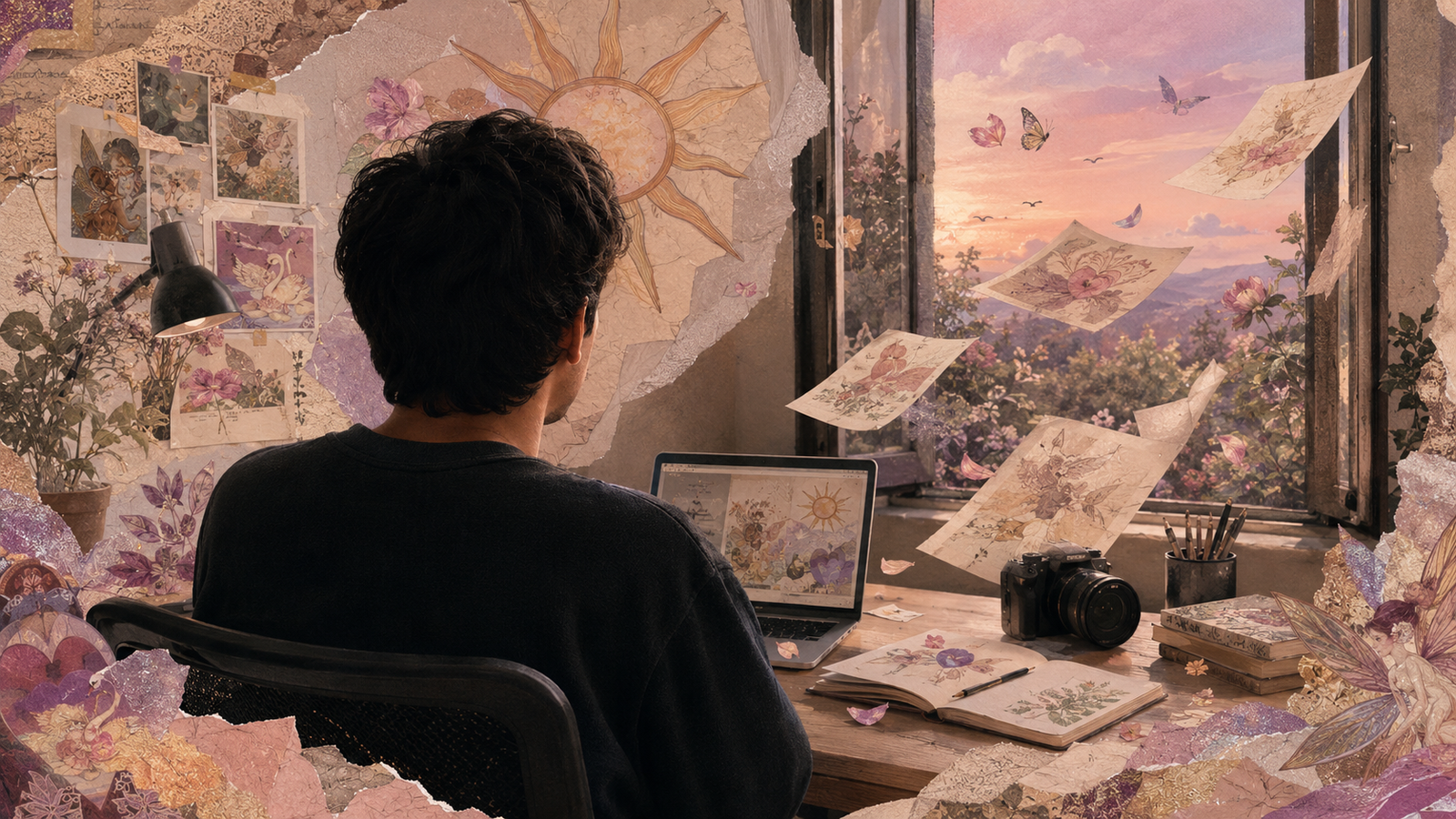
Making the work is private. Publishing it feels like walking naked into a crowded room.
Every artist LOVES to create.
Then it is time to show the work and they freeze.
There is this weird feeling that arrives when something which existed safely inside your room is about to enter somebody else’s screen.
Until that moment, the work belongs to you.
You can love it. Hate it. Delete half of it. Make another version. Nobody is watching. Nobody is counting. Nobody gets to tell you what it means.
Then you hit Publish and suddenly the door is open.
People can judge it.
Worse, they can ignore it.
You can spend five hours editing something that receives 200 views while another person points at floating text for seven seconds and gets two million.
Now there is a views count. A retention graph. Likes. Saves. Comments. Followers gained. Followers lost. An entire scoreboard appears beneath the thing you made from your heart.
And little by little, the thing you used to love turns into a performance.
You stop asking:
What do I want to make?
And start asking:
What will make them watch?
That is the strange trap of becoming visible.
You need the world to see your work but the moment the world sees it, you risk seeing the work through the world’s eyes too.
Before every beginning, my heart tried to stop me
I have felt this fear almost every time I started showing my work.
I felt it with VR Marvelites.
I felt it with my personal channels.
I felt it again when I decided to finally share my own ideas, experiences, systems, philosophies, and personality.
The work could be ready. The thumbnail could be finished. The caption could be written. The Publish button could be sitting right there.
But my body would behave as if clicking it might set the house on fire.
My heart would beat faster. My mind would start having second thoughts. One minute would feel like ten because I was no longer waiting for the upload.
I was waiting to find out whether it was safe to be seen.
- Who will watch it?
- Will my friends think it is cringe?
- What will my family say?
- What if the video gets no views?
- What if it does get views and suddenly everybody knows?
That last fear is the weirdest one.😭
I want to be seen.
But in my mind, I don’t want to be seen.
On 19 June 2026, I finally launched my Fun Little Videos. I had already recorded around a dozen and edited eight of them. I had spent months preparing, practising, fixing my speaking, improving my delivery, learning the edit, and slowly becoming somebody who could face the camera without needing a week-long “preparing” period.
The deadline I had given myself was my twenty-third birthday.
Before that birthday arrived, I wanted to demolish one fear:
SOCIALISING MY IDEAS.
Would I take the leap or not?
That question became my spearing force.
So I clicked Publish.
And then…
Nothing happened.
The walls did not collapse. The room remained the same. But my mind became quiet.
Every time I finally publish something I have been carrying for too long, I feel a burden leave my body. My head becomes light. There is this peaceful, almost intoxicated feeling as if the mind had been holding its breath for weeks and finally remembered how to exhale.
The fear is real.
The catastrophe is imagined.
The work becomes heavier while you hide it
I used to think I was protecting the work by keeping it private.
Sometimes I was.
New ideas need privacy. They need enough time away from metrics, opinions, trends, and premature advice to discover what they actually want to become.
But after a point, privacy stops being protection.
It becomes avoidance.
The unpublished article sits inside your mind. The unposted video follows you throughout the day. The project you keep “perfecting” begins to burden itself and you look for another project to LEAVE (brutal right? That’s how we are).
That is why Your work works on you more than you work on it.
The longer an important action remains unfinished, the heavier it becomes. You are not only carrying the work anymore. You are carrying every imagined reaction to it.
Publishing ends the imagination phase.
It gives you reality.
Maybe people love it.
Maybe they misunderstand it.
Maybe fourteen people see it and one of them is your second account.
GOOD.
Now you know something.
Before publishing, fear can invent unlimited outcomes. After publishing, you receive one actual outcome and actual information is much easier to work with than an imaginary “what ifs and what will happen/s”.
This is why showing your work is not merely marketing. It is part of making the work.
An idea kept completely private can only develop through one mind. Once shared, it enters conversations. Somebody asks a question you never considered. Someone connects it to an experience you have never had. A comment reveals that your explanation is confusing. A retention graph shows exactly where attention left the room.
Improvement comes from feedback.
The views count is not proof of your value. But it is information.
The retention graph is not a judgment. It is a map showing where the communication broke.
Metrics become dangerous when you use them to measure the creator.
They become useful when you use them to improve the creation.
Create for yourself. Show it for the work.
This is the balance I am trying to build.
All the ART is for MYSELF.
I create because I love creating. I write what I want to read. I make videos I can watch ten times because the edit makes my gut feeling dance. I do not want the algorithm sitting beside me during the first draft whispering what will perform.
But “I create for myself” cannot become another sophisticated excuse to hide forever.
You make the work for yourself.
Then you show it because the work deserves a life beyond YOU.
I think of creativity as planting a tree.
You choose the seed because you love it. You water it with your curiosity. You feed it with your experiences. You protect it while it is small enough.
But eventually, the tree has to grow outside.
It needs wind. Weather. Sunlight. Seasons.
And if you keep loving and caring for it, one day it becomes large enough to shelter other people.
You did not plant it only for the shade.
You planted it because you loved growing the tree.
The shade is the side effect.
That is what showing your work can do. The article that helped you understand your own mind may give somebody else the sentence they needed. The system you created for yourself may become another person’s starting point. The story you were embarrassed to share may make someone feel less alone.
YOUR ART DESERVES TO BE SEEN.
Not because it is entitled to views.
Not because it must make money.
Not because everybody is required to care.
It deserves to be seen because visibility is one of the environments in which creative work grows.
The publish button is a muscle
I don’t think the fear of being seen disappears through one grand act of courage.
You develop the instinct of hitting Publish again and again.
That is it.
The first upload feels like walking onto a stage naked.
The tenth feels uncomfortable.
The hundredth becomes Tuesday.
Every repetition teaches your nervous system:
We showed something. We survived. We can do it again.
Here’s How to Reinvent Yourself Every 90 Days (Step-By-Step)
This is not a mindset you think yourself into.
It is evidence you accumulate and build your “Creative Confidence”.
The first video I recorded took days of rehearsal and multiple days to shoot. Months later, I could see a day-and-night difference in my articulation, confidence, editing, framing, and delivery.
The work did not merely become better.
The work made me better.
That is another reason you must show it.
You think you are practising content, but the content is practising courage inside you.
And when the fear of judgment returns, I remember something Jun Yuh said:
You’ll never be judged by someone who is doing more than you.
The person doing more understands how much effort it takes to make something. They know the frustrating drafts, awkward takes, sleepless nights, wrong decisions, embarrassing beginnings, and invisible repetitions behind one finished piece.
They may give you criticism.
Good.
Criticism from somebody doing more than you help you grow.
But casual judgment usually comes from the seats.
Do not let spectators coach the player. NEVER. (Looking at you football and cricket fans)
If one particular person has become so loud that you cannot create freely, deal with the real relationship. Talk to them. Set a boundary. Stop showing them unfinished work. Mute them if necessary.
The goal is to care about the right things.
Care about useful feedback.
Care about becoming better.
Care about finding the people who see the world like you or see it differently enough to expand yours.
Create like a kid.
Protect the work while it is young.
Then SHOW YOUR WORK.
Hit Publish.
Leave the imaginary prison.
Make the next thing.
Remember: JUST MAKE STUFF
Until then,
Dewansh Jain
Great content! Keep up the good work!