

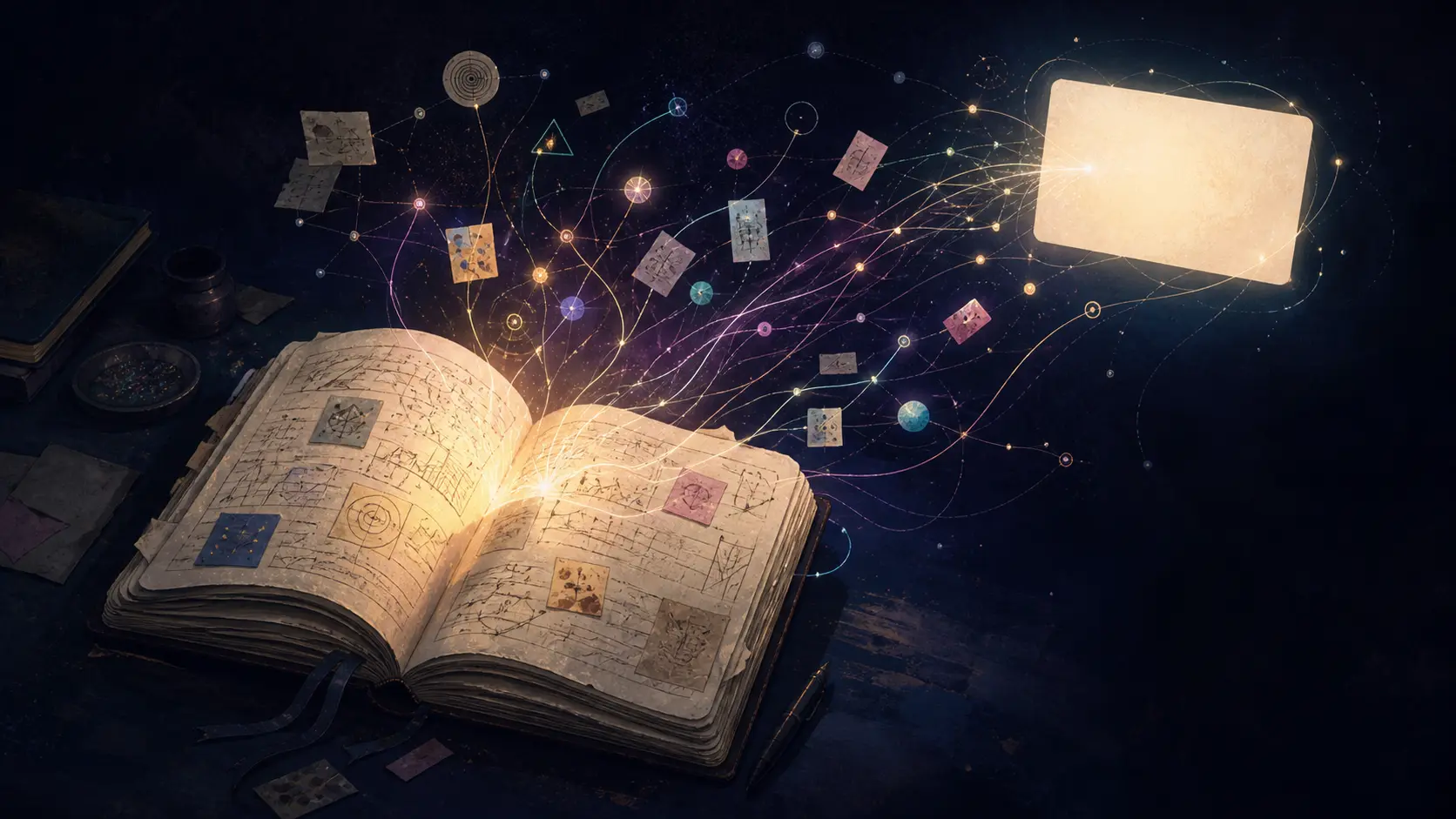
How to Turn a Commonplace Book Into a Creation Brain
Turn scattered observations into context, connected thinking, and work only you could make.
Somewhere inside my old laptop are hundreds of ideas I will probably never see again.
Whenever I had a thought, I would just open Windows Notepad.
- One file for an article idea.
- Another for some product I wanted to build.
- A random line from a podcast.
- Something I noticed in a movie.
- Something weird I noticed about myself.
- A question I wanted to come back to later.
I would write it down, save the file somewhere, close it… and basically never see it again.
And Notepad wasn’t even the only place.
Some ideas were inside physical journals. Some were in my phone notes. Google Keep. Evernote. Notion. Screenshots. Bookmarks. Random browser tabs I convinced myself I would come back to.
Then when I changed laptops, an entire layer of my thinking basically disappeared with the old one.
For a long time, I thought I had an idea problem.
Like maybe I just wasn’t creative enough. Maybe I needed to consume more. Read more books. Watch more videos. Find more interesting things.
But that wasn’t the problem at all.
I was having ideas constantly.
I just had no reliable place for those ideas to live.
And more importantly, I had no system for finding them again when I actually wanted to make something.
That distinction matters even more to us now because of AI.
AI can generate more information, more ideas and more words than I could possibly consume.
That part is becoming cheap.
What is becoming more valuable is everything that came from you.
- The weird observation you made three years ago.
- The question you couldn’t stop thinking about.
- The experience that changed how you see something.
- The connection between two completely unrelated things.
- Your taste.
- Your judgment.
- Your context.
Because if you don’t capture those things when they happen, no AI model can magically recreate the exact thought you allowed to disappear.
And the funny thing is, people have been dealing with this problem for centuries.
They had something called a commonplace book.
A place where curious people collected ideas, observations, quotes, knowledge and things they wanted to remember.
I think we need that same idea today. But I also think we need to take it one step further.
Because I don’t just want somewhere to store my ideas.
I want those ideas to eventually become articles, videos, products, projects and things that exist in the real world.
A commonplace book gives your ideas somewhere to live. A Creation Brain gives them a path into the world.
The original tool for a curious mind
Long before Notion, Obsidian or the phrase “personal knowledge management,” people copied passages, observations and ideas into books organized around subjects they wanted to return to.
These were not necessarily private diaries. They were working collections: part memory, part research desk, part record of a mind in motion.
The problem was familiar even then. A note could be captured and still become impossible to find. By 1706, John Locke’s method for indexing a commonplace book had appeared in English. Readers assigned entries to headings and used a compact index to retrieve them later.
Harvard’s history of note-taking shows how people combined material from books, speech and personal observation and how the arrangement of those fragments revealed the compiler’s own interests and way of thinking.
Henry David Thoreau began copying passages that struck him as a student. According to Harvard’s account of his reading life, he eventually filled twenty commonplace notebooks with roughly a million words.
The point is not that you should collect a million words. (lol)
The point is that serious readers and thinkers have always needed a place where what they encountered could MEET what they thought.
The container changed: bound books, loose paper, index cards, digital notes but the need did not.
I found the practice before I knew its name
My path to the commonplace book began after losing a business.
I had built VR Marvelites around the virtual-reality industry. When Google deleted the account, I was devastated. I later started another channel, but I could feel myself entering another narrow room. I loved building on the internet. I did not want to spend my life confined inside a single niche.
That was when I found Dan Koe and his idea of the one-person business: you could become the niche. Your interests, skills and knowledge did not have to be embarrassing distractions from one another. You could explore them, connect them and build from them.
Around 2023, I took his 2 Hour Writer course. Inside its Notion system was a page called The Queue.
The instruction was simple: whenever you found a thought, quote, idea or question you did not want to lose, put it in the Queue.
I did not yet know the phrase commonplace book. I just knew I had found something I had needed for years.
There was an immediate mental relief in it. I no longer had to keep an idea alive by rehearsing it in my head. I could capture it, return to what I was doing, then choose later whether it deserved anything more.
Austin Kleon eventually gave me the exact name for the practice. His books and his own commonplace diary also pushed me to carry pocket notebooks, so paper could be available when an idea arrived away from my desk.
Then I found Ryan Holiday’s index-card system. He learned it from Robert Greene, writes ideas on individual cards, files them by theme and later rearranges them while working. Holiday describes his commonplace book as both a starting point and a way to make connections; all of his books came together from those cards. The cards were not an archive he admired. They were material he used.
Dan gave me the Queue. Austin gave me the name and the pocket notebook. Ryan helped me see how fragments could become finished work.
I tried the practice in Notion, on paper and eventually in Obsidian. Over three years, hundreds of ideas accumulated.
For the first time, I could see what my mind kept returning to.
Curiosity. Polymathy. Creation. Knowledge. Systems. Taste. The strange gap between consuming something brilliant and making anything from it.
My observations had become usable.
But there was still a problem.
A full commonplace book can still leave you with a blank page
I had built a central place for ideas, but capture alone did not make me a creator.
I could save a hundred highlights in a week and still sit in front of an empty Google docs thinking:
I don’t know anything.
I don’t have a good idea.
I need to research a little more before I can write.
That was the most frustrating part. I knew I was learning. I felt intelligent while I read, watched and listened. But when it was time to make something, I could not see how I thought. I could not find the ideas I had generated or recognize the taste running through them.
The blank page made me feel like a loser.
So I did what many curious people do: I collected more.
Another research batch. Another saved video. Another tab. Another clever system for organizing the material I was still not using.
This is where a commonplace book became my “digital hoarding” place.
The software may look sophisticated. The folders may be pristine. Retrieval may be excellent. Yet the system is still optimized around possession: How much have I stored?
I used Tiago Forte’s PARA method in Notion, and it genuinely made my life easier. That is what a Second Brain does well: it helps you store and organize information so you can find it again.
But I needed a different finish line.
I did not want to be the curator of an immaculate warehouse.
I wanted to think, connect and create.
The four days when my notes finally began to move
On January 19, 2026, I opened a notepad and wrote three questions that had been haunting me for years:
- What do I want to extract from the things I consume?
- If I do not know what I want, why am I consuming them?
- Why am I building a curiosity-management system if I cannot explain what it is for?
I had a vision, a mission and shelves of material. I still could not verbalize the purpose of my own system. As I said in a voice note that day, the idea was noise inside my head. I needed to turn that noise into a voice.
The next four days changed the direction of my work.
Day one: I stayed with the questions instead of escaping into another tool.
Day two: I realized that useful consumption begins with intent. If I open a video because I am trying to close a gap, answer a question or develop a perspective, I know what to notice. If I am watching for entertainment, I can enjoy it as entertainment instead of anxiously pretending it is research.
Day three: I began testing methods for extracting individual ideas from videos, books, reels and my own journals.
Day four: the complete movement finally worked. I could capture raw material, turn it into atomic notes, connect those notes and use them to make something.
One line from the experiment still explains it best:
A journal is ore. An atomic note is a refined bar.
The journal entry matters. The highlight matters. The messy voice dump matters. But each is still raw material. Its useful ideas must be separated, named in language I understand and made small enough to move.
That was the missing bridge.
Not another place to store knowledge. A system designed around what the knowledge could become.
That is what I call a Creation Brain.
Commonplace Book vs. Second Brain vs. Creation Brain
A commonplace book is a place to collect what catches your attention: lines, questions, observations, stories, ideas and subjects you want to explore.
A Second Brain makes a larger body of information easier to organize and retrieve.
A Creation Brain is organized for movement. It helps you turn what you notice and know into original work.
The distinction is not about the app. You could build all three inside the same notebook or the same Obsidian vault.
The distinction is what the system asks you to do next.
Storage asks: Where should this go?
Creation asks: What does this mean, what does it connect to, and what could I make from it?
My complete Consumption-to-Creation Loop has more stages, but the essential movement can be understood in five:
1. Notice
Creation starts before the note.
It begins when something creates friction in your attention: a sentence you disagree with, a question that will not leave, a recurring mistake, a detail from a conversation, a result you did not expect.
I call this a Curiosity Spark.
Do not capture something only because it sounds intelligent. Capture what produces a reaction in you. That reaction is often where your point of view begins.
2. Capture
Give the spark one trusted place to land.
Paper or digital does not matter as much as reliability. The purpose is to remove the fear of forgetting without breaking the moment that produced the idea.
Capture enough context to understand the thought later:
- What did I encounter?
- What caught my attention?
- Why did it matter to me?
- What question or possibility did it create?
A copied quote with no reaction is somebody else’s thought sitting in your vault. Add the sentence that explains why you kept it.
3. Modularize
Distil the raw capture into one clear, reusable idea written in your own words.
I call this a Mental LEGO: a small piece of developed thinking that can stand alone and combine with other pieces.
This is the step I had skipped for years. I saved whole articles, enormous journal entries and hours of video, then expected my future self to excavate them while trying to create.
Modularizing reduces the job. You are no longer asking, “What was inside that two-hour podcast?” You are holding one thought you can explain.
My Zettelkasten guide goes deeper into turning raw material into atomic notes. But you do not need a sophisticated setup to begin. Take one capture and finish this sentence:
The useful idea here is…
Then explain it without looking at the source.
4. Connect
One note is useful. Connected notes begin to show you how you think.
Link the Mental LEGO to an experience, an opposing claim, another note, a person it could help or a project where it belongs.
This is where the commonplace book stops being a collection and becomes a thinking environment.
When several notes keep gathering around the same question, you no longer need to force a topic. The pattern is already asking to become something.
5. Create
Put the connected notes under a deadline and assemble them into public work.
An article. A video. A framework. A product experiment. A useful answer. I call a finished piece that demonstrates what you know an Authority Asset.
This step cannot remain optional.
Without creation, capture can become creative procrastination that feels productive because your database keeps growing. Treat creation with the same obligation you give paid work. That does not mean draining all the joy from it. It means refusing to make inspiration responsible for your promises.
My 8-Note Method is one way to assemble Mental LEGOs into an article. The principle is: stop trying to write a finished piece from an empty page. Build it from thoughts you have already developed.
Why this matters more when AI can write for you
Give an AI a thin prompt: “Write a productivity article about prioritizing time” and it can return something fluent, orderly and completely forgettable.
The problem is not that the machine is incapable of arranging sentences.
It does not know the idea you wrote into a lost Notepad file three years ago. It does not know what your failed business changed about the way you see niches. It does not know the sentence your mother said after you launched a product, the contradiction you noticed at work or the judgment you formed after testing a system for four days.
If those details were never documented, no prompt can faithfully reconstruct them later.
This article is a live example.
It did not begin with: “Write me an article about commonplace books.”
I recorded more than thirty minutes of answers about the lost files, Dan Koe’s Queue, Austin Kleon, my blank-page frustration, the January breakthrough, CurioRabbit, the proof I could defend and the claims I did not want to make.
I decided what belonged. The AI helped me interrogate, organize and assemble it.
That is the relationship I want with AI.
I do not want it to replace the part where I notice, experience, judge and choose. I want it to help the material I have already lived and preserved move further.
Your Creation Brain becomes the context layer between your mind and the model. Instead of asking AI to impersonate a person with a point of view, you can give it the raw material from which your point of view was built.
That still requires judgment. You must reject the line that sounds clever but is not true. You must protect private material. You must decide what can be published. You must remain the author.
I explain that division of labour more fully in The AI Authorship Framework.
What this system has changed for me
My first serious articles for my personal brand dragged across months because I was figuring out every part from scratch. I was no longer answering a narrow search query inside a niche. I was trying to build original arguments from my own interests and experience.
Eventually, the time fell from months to weeks. By June 2026, I could produce two or three polished articles in a week. I now write more than 2,000 words on many days not because I permanently defeated resistance, but because I stopped asking the blank page to supply both the ingredients and the meal.
The same system supported fourteen short videos in under twenty days while I was working full-time.
It also helped me build CurioRabbit.
That product began as my own obsession with giving curiosity somewhere to go. Over roughly seven months, experiments around Zettelkasten, the Feynman technique, questions, learning paths and knowledge gaps became a working product. I hard-launched it after it had reached about one hundred users. It is now around one hundred and fifty.
My video about the commonplace-book practice has reached roughly 2,200 views, 100 likes and 70 saves. Those are modest numbers on the internet. I include them because they showed me that this was not only my private frustration. Other curious people were also tired of losing ideas and facing the blank page with a full saved folder.
Build the smallest version today
Do not begin by downloading fifteen plugins or copying another person’s vault.
Start with one page called Commonplace and one public commitment.
For the next seven days:
- Notice one thing each day. A question, observation, line, experience or disagreement.
- Capture why it mattered. One sentence is enough.
- Turn it into one Mental LEGO. Explain the useful idea in your own words so it can stand alone.
- Connect it to something you already know. Another note, a story, a problem or a person it could help.
- Create one small piece by day seven. A post, a short video, a diagram, an answer or the first section of an article.
The deadline matters. It changes the commonplace book from a place where ideas go to sleep into a place you visit for building material.
If you want to see my complete capture and organization system, read How I Capture & Organize My Ideas & Thoughts (Complete System). Then choose the smallest version you will actually use.
The system is not successful when every note has perfect metadata.
It is successful when a thought you would have lost becomes something you can use.
Give your curiosity somewhere to go
This is for the curious person who reads, watches, saves and learns constantly but has no coherent way to turn that material into original public work.
You may be building beside a full-time job. You may not have a niche. You may have thousands of notes or none. You may be using AI every day and still feel that the work coming back sounds nothing like you.
You do not need another flood of information.
You need to preserve what your attention selects, develop what it means and give it a path into the world.
That is what curious minds were trying to do when they kept commonplace books centuries ago.
The modern opportunity is to complete the movement.
If you want my help building it from Step 0, the Consumption-to-Creation Lab is the guided version of this system. We build your Creation Brain, turn what you consume and experience into reusable Mental LEGOs, and use those pieces to publish at least one Authority Asset with AI supporting the process without swallowing your thinking or voice.
The page will let you join the waitlist for the next opening.
But whether you join or build it alone, begin now.
Give your ideas somewhere to live.
Then give them a path into the world.
Cheers,
Dewansh Jain