
Growing up is useful for paying bills. It is TERRIBLE for making stuff.
I remember the exact day I first wanted to become an artist.
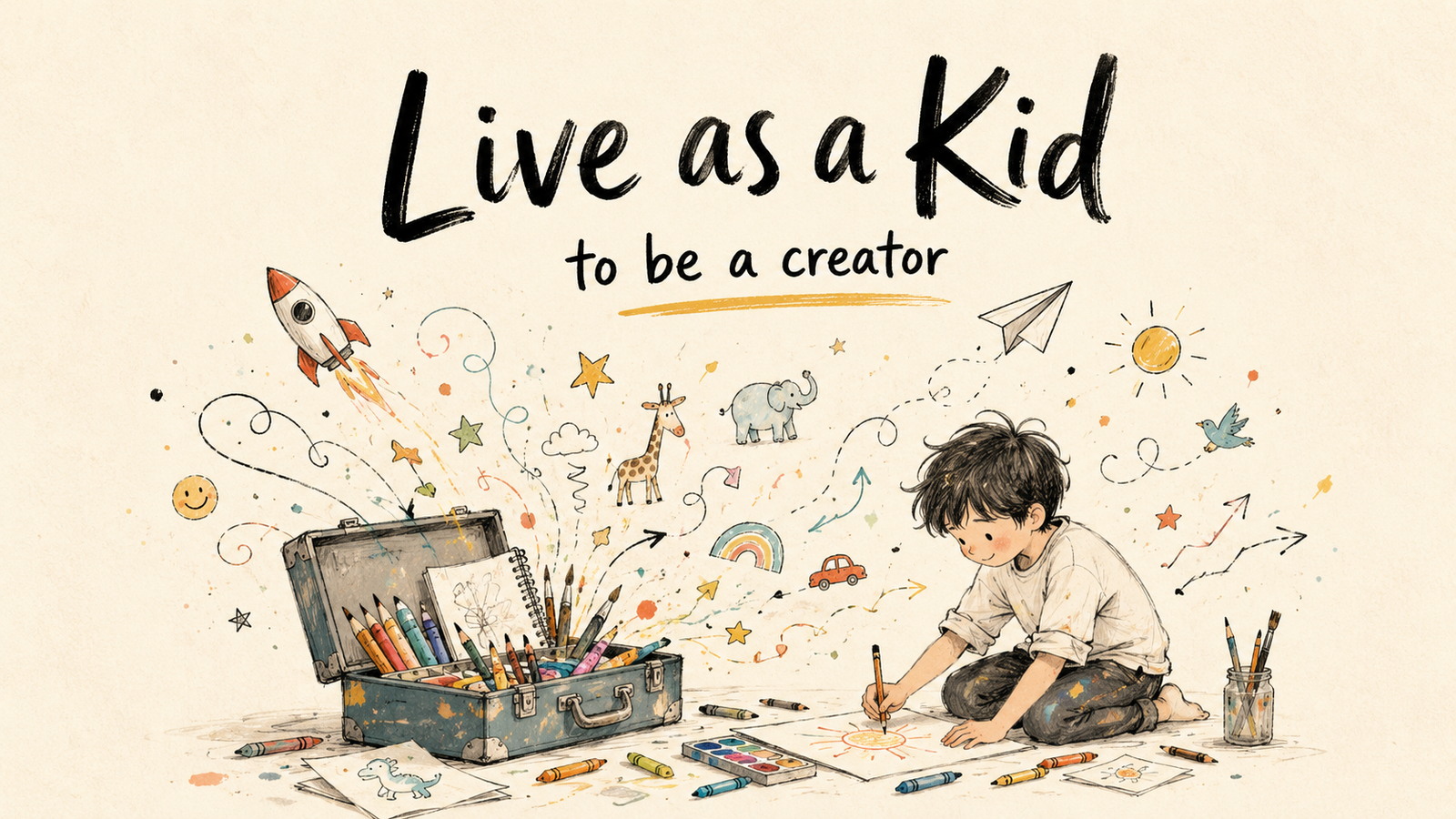
I was in fourth standard when I saw one of those suitcase-shaped art boxes in a shop.
You know the one.
Markers.
Crayons.
Colour pencils.
An entire creative universe packed inside a plastic suitcase.
I begged my mom to buy it for me.
Then I came home and started drawing.
I drew during the day.
I drew at night.
I opened a drawing app, looked at the step-by-step pictures of animals, Pokémon, and characters, and tried to copy them exactly.
I made sketches, watercolour paintings, origami, DIY things anything that could be created, I would create.
I never stopped to ask:
Is this original?
Is this real art?
Am I talented enough?
Can this become a career?
What will people think?
I just had an art box.
So I made stuff.
That might be the purest creative system I have ever followed.
A child does not have a creativity problem
Children draw before they know what “good drawing” means.
They dance before learning whether they have rhythm.
They sing before someone tells them their voice is bad.
They ask questions without worrying whether the question makes them look stupid.
Then something changes.
We grow up.
We learn the rules.
We learn what is cool and what is cringe.
We learn which hobbies are “useful,” which careers are “respectable,” and which ideas should remain safely locked inside our heads.
We stop making things and start evaluating ourselves making things.
That is the real difference.
A child is inside the experience.
An adult is standing outside it, watching himself through everybody else’s eyes.
No wonder we freeze.
We are trying to create and review the performance at the same time.
The fastest way to kill creativity is to call it “ART”
When a child throws colours onto paper, he is not trying to produce ART.
He is doing stuff.
But the moment an adult says, “I am making art,” an entire courtroom appears inside his head.
Is it good?
Is it original?
Does it have meaning?
Will people judge me?
Will anybody care?
Steven Pressfield calls that voice The Resistance.
Julia Cameron calls it The Censor.
I call my videos Fun Little Videos.
Because art critics are interested in art.
So DON’T CALL IT ART.
Just make stuff.
This is not wordplay.
It changes your relationship with the work.
“Art” carries reputation.
“Stuff” carries possibility.
Stuff can be messy.
Stuff can fail.
Stuff can be weird.
Stuff can be made again tomorrow.
Not knowing is a creative advantage
Kids do not know what cannot be done until an adult tells them.
That ignorance creates a tiny window where the impossible still feels normal.
Austin Kleon writes about Orson Welles making Citizen Kane at twenty-five. Welles said he accomplished seemingly impossible things because he did not yet know they were impossible.
That sounds ridiculous until you notice the opposite happening to adults.
The more we learn about a field, the more careful we become.
We learn the correct process.
We learn what usually works.
We learn what professionals never do.
Useful knowledge slowly becomes a fence.
The goal is not to remain ignorant.
The goal is to keep returning to not knowing.
Try a medium you are terrible at.
Attempt the problem before watching fifteen tutorials.
Make a version using the tools you already have.
Mess around.
Find out.
Adrian Belew learned to recreate guitar sounds without knowing that his heroes had used studio effects. Because nobody told him the “correct” explanation, he had to invent his own.
Sometimes missing information becomes the space where your style is born.
I never had a career plan. I had curiosities.
That child with the art box wanted to become an artist.
Then an animator.
At fifteen, I started learning HTML, CSS, Python, JavaScript, Android development, and game design.
Not because these skills formed some genius ten-year strategy.
I wanted to make cool things—and, yes, make MONEY.
I tried running eight different tiny businesses. One of them needed a website. A website needed writing. The writing started getting attention.
So I doubled down.
Writing became a skill.
Then a hobby.
Then a profession.
Then the foundation beneath almost everything I create today.
I did not sit down and correctly choose my life’s work.
I followed play until the dots began connecting behind me.
Even my encyclopedia became a playground.
I read it again and again, took notes, added footnotes, and made my own theories.
My children’s magazines were prized possessions. Every new issue made my eyes glitter.
Years later, I learned twenty skills in twenty days while giving exams and recording the entire experiment.
Now I call the same instinct Skill Sampling.
It sounds like a framework because Adult Dewansh gave it a name.
Kid Dewansh would have simply called it:
Trying cool shit.
Your eyes know before your spreadsheet does
Adults ask:
Which skill will give me the highest return?
Children ask:
Which one looks the most FUN?
The adult question is not wrong.
It is simply too early.
You cannot calculate the return on a life you have not experienced.
You do not know whether you love boxing, dancing, coding, cooking, filmmaking, or painting by staring at descriptions of them.
You have to taste them.
Like standing inside an ice-cream parlour with thirty-one flavours.
You don’t select your lifelong flavour using a spreadsheet.
You ask for the tiny spoon.
You sample.
This is why Experiments should always be Fun
Start with the juicy part.
Make the cool kick.
Cook the dish you actually want to eat.
Edit the scene you can already see inside your head.
Build the ridiculous feature.
Momentum should come before discipline.
If the sample lights you up, go deeper.
If it tastes terrible, move on without turning it into an identity crisis.
A child does not say:
I failed to become a guitarist.
He says:
I don’t want to play this anymore.
And then runs towards something else.
There is wisdom in that lightness.
Children create because the activity is the reward
The biggest birthday present I ever made for my mom took me almost an entire year.
I locked myself inside my room.
I planned the slides, bought cardboard, thought about colour schemes, made things, destroyed things, and cleaned up an unbelievable amount of garbage.
My friends called me outside to play.
I stayed with the project.
Nobody was paying me.
There was no algorithm waiting.
No audience.
No productivity system.
Just love concentrated into cardboard.
We think children have short attention spans.
But watch a child doing something he genuinely loves.
The world disappears.
Maybe our attention did not become weaker only because we grew older.
Maybe we also stopped giving it things worth loving.
That is why hobbies matter.
They teach you while you think you are playing.
They become habits.
Habits become a lifestyle.
And somewhere along the way, the thing you did “for no reason” gives you a reason to live differently.
Living as a kid does not mean becoming childish
I am not telling you to abandon responsibility, ignore money, or draw on the walls.
Somebody still has to clean the crayons.
Living as a kid means protecting the conditions under which the creative kid can appear.
The adult in you builds the playground.
The kid in you plays inside it.
The adult protects time.
The kid follows curiosity.
The adult buys the materials.
The kid makes a mess.
The adult creates a routine.
The kid experiments inside it.
The adult finishes and ships.
The kid keeps the work alive.
You need both.
An unsupervised child may never finish anything.
An overbearing adult may never begin.
Your job is not to silence either one.
It is to become a loving parent to your own creativity.
How to live as a kid again
Do not turn this into another seventeen-step self-improvement protocol.
Try these instead:
Make something that does not need to be good
Draw badly.
Record a weird video.
Write one page nobody will read.
Remove quality as the entry fee.
Follow one unnecessary curiosity
Read about something that cannot improve your career.
Learn a card trick.
Try a dance move.
Build a useless tool.
Let fascination be enough.
SHAMELESS PLUG: You’ll love CurioRabbit
Attempt before asking for instructions
Give yourself twenty minutes to figure it out.
You can watch the tutorial afterward.
First, give yourself the chance to invent.
Share your excitement before it becomes polished
When children discover something amazing, they run towards somebody and say:
LOOK AT THIS!
That is the energy I want behind socialising my ideas
Not “building thought leadership.”
Not “growing an audience.”
I learned something.
It blew my mind.
Now I need to show you.
Stop watching yourself
Every time you think, “What will they think?”, you leave the playground and enter the courtroom.
Return to the activity.
Become the verb.
Write.
Draw.
Dance.
Build.
Play.
The creative kid never disappeared
You did not lose your creativity when you grew up.
You buried it beneath instructions, labels, comparison, usefulness, and the fear of looking stupid.
The kid is still there.
He is the part of you that opens seventeen tabs because the world is too interesting.
The part that wants to learn boxing, make an app, write a book, cook something weird, design a game, record a video, and understand why birds suddenly know where to fly.
You keep telling him to focus.
Maybe listen first.
You do not need to become a child again.
You need to stop bullying the one who never left.
Give him an art box.
Give him an empty page.
Give him enough time to make a mess.
Then stay out of his way.
That is how you live as a kid.
And that is how you become a creator.
Until then,
Dewansh Jain